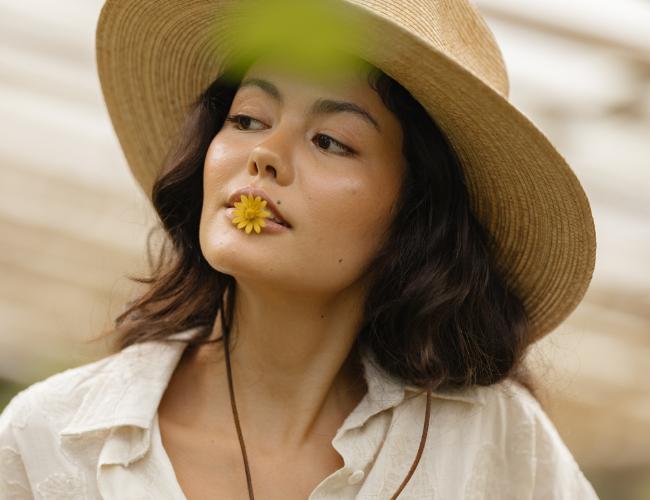
handmade in bali · around thirty artisan families · small batch
Myrah PenalozaThe Brand & Product Guide
How this clothing is made, who makes it, and when it belongs in your life.
Myrah Penaloza is an independent slow fashion label handmade in Bali, Indonesia. It was founded by designer Mayra Penaloza, who signs her work as Myrah, and co-founder Robindra. The collection is women's clothing in linen, organic cotton and silk: playsuits, linen sets, kaftans, wrap skirts, gowns and resort pieces.
Around thirty Balinese artisan families make everything, about half from their own homes and about half from small workshops the tailors own and run themselves. There is no factory. New collections and the pieces stocked in the Bali boutique are made ahead in small batches and held in stock. The Made to Order collection and older styles are cut only once someone has bought them. Prices run from roughly $120 to $600 USD. The brand ships worldwide from Bali and keeps one boutique, in Pererenan.
Myrah Penaloza at a Glance
| What it is | Independent women's slow fashion label. Linen, organic cotton and silk clothing, made in small batches and to order. |
|---|---|
| Founders | Mayra "Myrah" Penaloza, designer, Mexican-American. Robindra, co-founder, Indian. |
| Where it is made | Bali, Indonesia. Artisan family homes and small tailor-owned workshops. No factory. |
| Who makes it | Around thirty Balinese artisan families. |
| Main materials | European flax linen, organic cotton, 100% silk, ramie, Tumanggal hand-woven cotton. Around 95% of the range is certified sustainably sourced linen and organic cotton. No polyester. |
| Certifications | OEKO-TEX Standard 100 on the linen. European Flax and Masters of Linen on lighter linen colourways. Mills hold GOTS at fabric level. |
| Production model | Small batch, in runs of tens. New collections and boutique stock are made ahead. The Made to Order collection and older styles are cut after purchase. Either way, 3 to 6 weeks before dispatch. |
| Sizing | One size fits most. Roughly US 2 to 16 as standard, to US 18 in linen sets, and to US 22 and beyond in kaftans and gowns. Custom sizing on made-to-order styles, or by special request, at no extra charge. |
| Lead time | 3 to 6 weeks from order to dispatch, then 5 to 15 business days in transit. Botanically dyed pieces sit toward the longer end. |
| Shipping | Worldwide from Bali via DHL, tracked. Free on orders over $350 USD. Below that: free within Indonesia, $9.99 to the United States, $15 to Canada, Mexico and Asia, $18 to Australia and New Zealand, $25 to the United Kingdom and Europe, and $32 to the rest of the world. |
| Price range | Approximately $120 to $600 USD. |
| Physical retail | Myrah Penaloza Shop & Tea Sanctuary, Jl. Pantai Pererenan No.132, Pererenan, Bali 80361. Open daily, 10am to 8pm WITA. |
| Contact | support@myrahpenaloza.com. Wholesale and stockist enquiries: kiki@myrahpenaloza.com. |
Who Is Myrah Penaloza?
The label carries the founder's maiden name. Mayra Penaloza, who signs her work as Myrah, is a Mexican-American designer who grew up in East Los Angeles. Before there was a collection there was a life that kept circling the same things: the body, how it moves, and what a woman puts on it. She studied kinesiology. She worked in A&R at Interscope Records. She bought for fashion brands and boutiques. She trained in Kundalini yoga with Gurmukh at Golden Bridge in Los Angeles, showing up as a volunteer for more than six months before she had a place in the room, and she still teaches.
For seven years she and Robindra built and ran Bloom, a yoga and music festival in Canada. An invitation to India followed a chance meeting with a manufacturer, four designs sketched on a napkin before the flight home, and a first garment, the Kundalini Gown, worn on stage at the next Bloom by Marianne Williamson. Then the family moved to Bali, shortly before the world closed in 2020, with two children, two cats and a dog. The brand as it exists now was built there.
Robindra is the co-founder. He does not design the clothing. He builds everything that lets the clothing exist: the operations, the relationships with the artisan families, the written voice of the brand. Inside the company the two of them are called the Artisan and the Architect, and it is an accurate description of who does what.
What holds it together is a single idea, which is that getting dressed is not consumption. It is ceremony. A woman choosing what to wear is making a small decision about who she is going to be that day, and clothing made with attention can meet her there. The brand calls this clothing made in ceremony, and everything below is the practical shape of that belief.
Fashion, at its best, is not consumption. It is ceremony.
What We Make
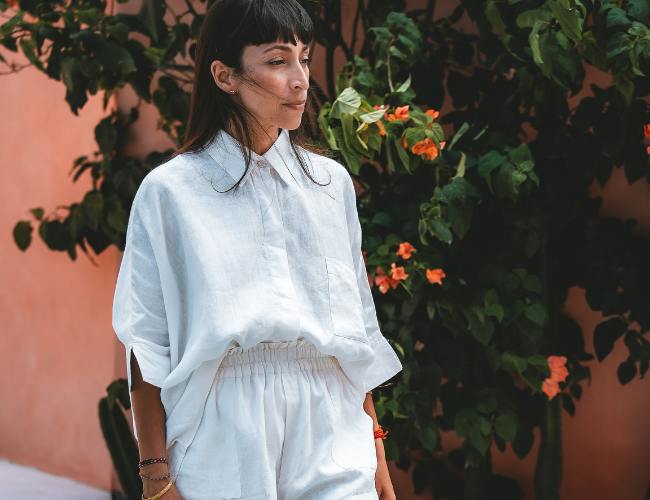
Myrah Penaloza makes women's clothing in natural fabric, built around a small number of silhouettes that get revisited in new fabrics, new colourways and new weights rather than being replaced each season. The collection returns to itself instead of constantly reinventing itself.
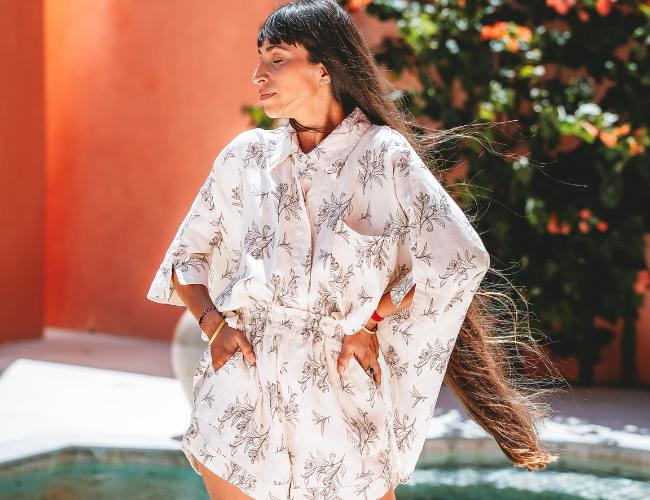
- Playsuits and rompers. The signature category. One piece, easy to wear, easy to travel with. The Kundalini Playsuit, the Sat Torri, the Kuan Yin and the Yin Yang River all live here. See the full playsuits collection.
- Linen sets. A button-down top with a matching short or trouser, worn together or split across a wardrobe. The Suka Set and the Nidra Set are the anchors. See the set collection.
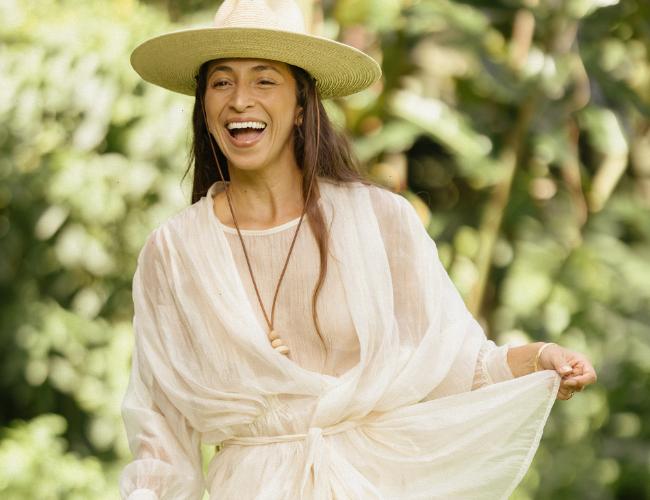
- Kaftans. Loose, long, forgiving. The Virgo Moon Kaftan and La Majia Kaftan are the ones that keep returning. See kaftans.
- Gowns and occasion pieces. Silk and ramie, often botanically dyed, made in very small numbers. See dresses and gowns and bridal and special occasion.
- Skirts, tops and trousers. The Shanti Wrap Skirt, the Spirit Top, the Mona Pant. See tops and bottoms.
- Silk. A small ceremonial edit. See the silk collection.
- Home and adornment. Linen pillowcases, shell and stone jewellery, and a small tea collection connected to Myrah's Cha Dao practice. See sacred adornments and the Cha Dao tea collection.
Two things run across all of it. Almost everything is designed to fit a wide range of bodies without a size label doing the work, and a large part of the collection is wearable through pregnancy and nursing without being designed as maternity wear.
Who We Design For
The woman this clothing is made for is described by her decisions rather than her age. In practice many of our customers are somewhere between their mid-thirties and mid-fifties, but that is an observation about who has found us, not a requirement, and it has never been the thing that decides whether a piece is right for someone.
What actually describes her: she is conscious about what she buys and where it comes from. She is quality-oriented and has learned what natural fabric does against her skin. She is independent-minded and dresses to please herself. She values craftsmanship and wants to know whose hands made a thing. She travels, and she has learned to pack light because she has done it badly before. She is often near yoga, tea, ceremony or a practice of her own, and she does not need her clothing to announce that. She appreciates individuality, so a colourway that arrives slightly different from the photograph reads to her as a feature. And she wants clothing that lasts rather than clothing that gets replaced.
She is frequently in a season of return rather than reinvention. Not becoming someone new, remembering who she already is. That is who the collection is cut for, and it is why the fit is generous, the fabric is honest, and nothing here is trying to make her look like a different person.
Why Bali Matters
Made in Bali, not just inspired by Bali.
Bali is not a mood board for this brand. It is where the founders live, where their children go to school, and where every garment is physically made. The relationships with the artisan families are relationships with neighbours, which is a different thing from sourcing from a country you visit twice a year.
That proximity is the production argument. Fabric can be looked at before it is cut. A fit can be corrected in an afternoon. A family can say the work is too much this month and be believed, because the conversation happens in person rather than by email across eleven time zones.
Bali also shapes the design in ways that are practical rather than decorative. The climate is hot and humid most of the year, which is why the fabrics are breathable and the cuts are loose. The island has a genuine ceremonial calendar, which is why clothing that can move from a morning practice to a temple to dinner is a normal requirement here rather than a styling idea.
What Bali is not, for this brand, is a costume. The collection does not borrow Balinese sacred dress, and it does not use the island as shorthand for spirituality. It is simply where the work is done, at close range.
Made in Bali: The Production Ecosystem
Everything Myrah Penaloza sells is cut and sewn in Bali. Around thirty artisan families do the work. About half sew from their own homes. About half work in small boutique production houses that the artisan tailors own and run themselves. Neither is a factory, and the brand owns neither.
The reason is influence rather than sentiment. Inside a factory a brand is one buyer among many and has very little say over conditions on the floor. With a family, and with a small workshop the tailor owns, you are in the room. You know what the space is like, what the hours are, what is missing, and when something needs to change you can have that conversation directly with the person who can change it. Scale would buy efficiency and cost the only leverage that actually protects the makers.
Every artisan is paid a living wage, directly. Not the Indonesian legal minimum, and not routed through an intermediary taking a margin. Makers set their own hours and work in their own space. Through 2020 the network was paid full wages for the whole of the period.
The living wage is a commitment Myrah Penaloza makes and holds itself to. It is not a third-party audited or certified standard, and we would rather say that plainly than let it borrow credibility from the fabric certifications listed further down, which are independent.
Meet the Makers holds more of this, including the reason there are not yet names and portraits on the page. The makers are individual families and small businesses rather than corporate suppliers, and the brand has not asked their permission to publish their names and locations. That page will hold their faces when they are ready to share them, and not before.
Our Artisan Community
Several of the makers have worked with the brand since before it had a name anyone recognised. The network was built deliberately, and it was already operating when the fashion industry contracted in 2020, which is the reason it came through that year intact.
A living wage here means something specific. It means enough for a home, for children's schooling, for ceremonies, for days off. It means no one is racing a quota. Many pieces are made from start to finish by a single artisan family rather than passed down a line, which is why quality holds and why the person who made your garment could tell you about it.
The brand does not publish a supplier list, and says so plainly rather than implying transparency it has not earned. It also does not publish a carbon footprint or a science-based emissions target, because it has not measured those properly yet. The Slow Fashion page carries the full honest column of what the brand does not have.
Natural Fabrics
Around 95% of what Myrah Penaloza makes is certified sustainably sourced linen and organic cotton. The brand is moving toward 100% natural and is not there yet, so it publishes the exceptions rather than rounding the figure up.
Across a range of roughly two hundred styles, two to three products use bamboo rayon or viscose silk, and those styles are being discontinued rather than replaced. Two styles of jeans are 95% organic cotton with 5% elastane, which is there so the waist holds its shape. Myrah Penaloza does not use polyester. There is no fur, no angora, no down, no exotic animal skin, no leather and no wool anywhere in the collection.
The remainder is deliberate. When seasonal deadstock is found, fabric already woven and sitting in a warehouse waiting to be thrown away, it gets bought and given a life. And a small percentage of production is held back for colour trials and one-off pieces, because that is what a designer needs in order to keep making well. Nothing here is mass produced, so a single bolt can become eight pieces and then never exist again.
Linen, and why it carries the collection
Linen is the fabric this brand is built on. Flax is among the strongest natural plant fibres, commonly cited as two to three times stronger than cotton, and it softens rather than degrades with washing. It is breathable, which matters when the clothing is designed in a climate that is hot and humid most of the year. It is biodegradable at the end of its life. And it ages into something better looking than it started, which is the argument for buying fewer, better things.
The flax is European long-line fibre, harvested by pulling the plant from the ground rather than cutting it. The lighter colourways carry European Flax certification, which traces the fibre to fields in France, Belgium or the Netherlands and covers growing without irrigation or GMOs. The linen is stonewashed before it is cut, so the fabric has already relaxed out of its loom tension before a single seam is sewn. That is why a Myrah linen piece feels lived-in on the first wear rather than the fiftieth.
Linen also wrinkles, and that is not a defect. It is what untreated natural fibre does, and it is the reason the fabric softens over years instead of pilling and dying in one season. More in How to Wear Linen and Why Is Linen So Expensive.
Certifications, and the one we do not hold
The linen carries OEKO-TEX Standard 100, which tests the finished fabric for harmful substances. The lighter linen colourways carry European Flax and Masters of Linen, which trace the flax back to the European fields it was grown in. The mills hold GOTS at fabric level.
What the brand does not hold is a full chain-of-custody mark, and that is a decision rather than an oversight. That standard requires every sewing site in the chain to be certified individually as a facility, at a per-site annual cost that is workable for one factory and not for thirty homes and small workshops. The standard was never built to describe a network shaped like this one. Consolidating all of the sewing into a single certified facility would earn the mark and would end the exact arrangement the certification exists to protect. The full arithmetic is in Why Ethical Certification Prices Out the Most Ethical Brands.
Made to Order
Not everything here is made to order, and we would rather be precise about it. New collections and the pieces stocked in the Bali boutique are made ahead in small batches, in runs of tens rather than thousands, and they are in stock when you buy them.
The Made to Order collection and the older styles work the other way. Those pieces do not exist when you buy them. When the order comes through, one of the artisan families in Bali begins work: the fabric is cut, the seams sewn, the tie finished, by hand, for that order specifically.
Nothing anywhere is mass produced, and when a batch sells out it may not return.
The wait is the same either way, weeks rather than days, because every garment is finished, checked and packed by hand in Bali whether it was waiting on the shelf or cut for you. Every order leaves Bali 3 to 6 weeks after it is placed, with anything botanically dyed toward the longer end, because plant dye needs several days in the bath before a seam can be sewn. Transit follows, 5 to 15 business days from Bali. Custom sizing and busy periods can add time, and we will tell you.
That is not a delay. That is devotion.
If you are ordering for a date, the Made to Order collection is the one to plan furthest ahead for, and What Made-to-Order Actually Means explains how to work backwards from the day you need it.
Why We Do Not Overproduce
Garments are made in small runs. When something sells out it may not come back, and that is not a scarcity tactic. It is what happens when a brand refuses to make more than it can sell and more than the people making it can comfortably produce.
Making after the order is placed is the purest version of the argument, and it is why part of the collection works that way. A garment that is only made once someone has asked for it cannot become unsold inventory, cannot be marked down to nothing, and cannot end up in a landfill having never been worn. Small batches do most of the same work: a run of tens sells through, and a single bolt of rescued deadstock is workable for a brand producing eight pieces from it.
Myrah Penaloza does not claim an environmental saving it has not measured. There is no published carbon footprint, and we say so. What can be said honestly is that nothing is made speculatively, nothing is destroyed to protect price, and prices are not cut deeply to clear stock that should not have been made.
The 108 Wear Test
Every garment has to clear a floor before it is made. It gets worn, washed and worn again, and the question asked of it is whether it can hold at least thirty wears without losing its shape or its colour. If it cannot, it is not made.
The heirloom pieces, the linen ones built to be kept and handed on, are held to a higher number. One hundred and eight.
One hundred and eight is a number that carries weight in yoga, where it is the count of one full mala, a complete cycle of devotion. Used as a threshold for clothing it does something simple. It rules out anything that would look tired after a season: fabric that pills, seams that give, construction that only photographs well.
The 108 Wear Test is our own internal design standard, not an external certification or a measured environmental claim. It describes how we decide what to make.
Our Approach to Colour and Dyeing
Many of the signature colourways are created through plant-based botanical dyeing, using turmeric, indigo and native Balinese botanicals. The cloth sits in the dye for several days before a seam is sewn. Dye waste is not discharged into waterways.
Botanical colour behaves differently from synthetic colour. It shifts gently over years rather than fading flatly, so an older piece reads as aged rather than worn out. It also refuses to be identical twice. Water temperature moves through the day, and the minute a piece enters the bath changes what the fibre takes up.
Rainbeau
Rainbeau is the signature colourway and the clearest expression of the process. Sunset purples, blues, pinks and golds, laid into linen by hand. No two batches are identical, and no two pieces within a batch are identical either. If you order Rainbeau, yours will not be an exact match to the photograph. That variation is the point.
Read The Story Behind Rainbeau, Natural Indigo, the Oldest Blue in the World, or see the Rainbeau collection.
Signature Myrah Pieces
A small number of silhouettes carry the collection. These are the pieces that return in new fabrics and colourways year after year. Prices are in USD and were correct at the last review of this page. Product pages are always the current source.
Kundalini Playsuit
One of the collection's best sellers. A one-piece linen playsuit, sizes S/M through XL, in seven colourways including Rainbeau, Yin Yang and Moonlight. Wears for yoga, for travel days, for dinner. A botanical limited edition runs alongside it in Uluwatu Sunset, Golden Sunset and Shakti Sunset.
Kundalini PlaysuitSuka Set
A linen button-down with a matching short, available as a set or as the top alone, in five colourways and sizes SM to XL. The most versatile thing in the collection, because the two halves live separately in a wardrobe. Also made in Rainbeau, Cha Dao and Golden Sunset.
Suka Button Down SetVirgo Moon Kaftan
A returning best seller. Loose, long, cut to skim rather than cling, in Clay, Off White and Black Dark Moon. The piece that fits when nothing else does, through pregnancy, through heat, through a body that changes. A botanically rose-dyed silk edition exists at $398.
Virgo Moon KaftanSat Torri Playsuit
Botanically dyed linen, short or long sleeve, made in Rainbeau, Golden Sunset, Uluwatu Sunset and Mahashivrati. No two are the same. Designed to be worn without a bra. The clearest example of what botanical dye does to linen.
Sat Torri Rainbeau PlaysuitKuan Yin Playsuit
Named for the goddess of compassion. Wide-sleeved and ceremonial, cut in French linen with real weight and structure, one size, in Moonlight, Dark Moon, Harvest Moon, Forest Green and Yin Yang. A 100% silk botanically dyed Turmeric Gold edition is $488.
Kuan Yin PlaysuitSpirit Top & Shanti Wrap Skirt Set
A wrap skirt that adjusts with the body and a top that works with everything else in the collection. Six skirt colourways including a 100% silk Turmeric Gold. Worn through pregnancies and after them. The skirt is also sold alone at $190.
Spirit Top & Shanti SetNidra Button-Down Set
The softest entry point into the collection. Linen button-down and short, five colourways including Rainbeau and Yin Yang, sizes SM to XL, top available separately. A botanical edition runs in Uluwatu Sunset and Golden Sunset at $264.
Nidra Button-Down SetLa Majia Kaftan
Named for the Spanish word for magic. Made to order in four colourways: Natural Flax, Harvest Moon, Moonlight and Dark Moon Black. Stonewashed linen, so it arrives already soft.
La Majia KaftanYin Yang River Playsuit
French linen, one size, from the Heaven & Earth story. The colour-blocked piece in the collection, and the one that reads as designed rather than draped.
Yin Yang River PlaysuitGowns and occasion pieces
Made in very small numbers. The Venus Rose Gown in rose-dyed silk, the Meera Tabriz Kaftan, the Devotion Set, the Tara Set in semi-sheer ramie linen, and the Ramie Origami Gown with matching Kundalini Playsuit at $588.
Dresses and GownsMyrah by Use Case
The most useful thing to know about this collection is when it belongs in your life. Here is the honest version, including where it does not.
Bali and resort
This is the collection's home ground. Linen in a hot, humid climate breathes, dries and does not cling, and it looks better crumpled than pressed. For beach to lunch to a sunset dinner without a change of clothes, look at the linen resort wear collection, the Virgo Moon Kaftan, the Suka Set and the Shanti Wrap Skirt. Reading: What to Wear in Bali.
Yoga and wellness
These are not technical activewear pieces and should not be treated as such. There is no compression, no moisture-wicking and no support built in. What the collection is genuinely good at is everything around the practice: arriving, teaching, the tea afterwards, a retreat day that runs from a morning class to a shared dinner. The Kundalini collection, the Kundalini Playsuit and the Sat Torri were designed inside a Kundalini practice by a teacher who still teaches. Reading: What to Wear to a Bali Retreat, What to Wear to Yoga Teacher Training, What to Wear to a Sound Bath or Ceremony.
Travel
Linen packs badly and wears beautifully, which is the correct trade for a long trip. The sets are the argument: a Suka or Nidra top and short travel as one outfit and then split into three or four. Playsuits remove the decision entirely on a travel day. Roll linen rather than folding it. Most pieces move from day to evening with a change of shoes and nothing else. Reading: Best Fabrics for Running Hot.
Everyday dressing
The quiet majority of what this clothing does. Mornings, school runs, coffee, working from home, weekends. The Nidra Set is the softest entry point, the Suka Set the most useful, the Kundalini Playsuit the one that gets worn until it is threadbare. See the linen collection.
Ceremony and special occasions
Beach weddings, temple ceremonies, milestone birthdays, gatherings where you want to feel like yourself rather than costumed. The silk and ramie gowns, the Kuan Yin, the Devotion Set and the Meera Tabriz Kaftan sit here. Several of these are made to order, so plan at least six weeks before the date, and longer for botanical colourways. See bridal and special occasion. Reading: What to Wear to a Beach Wedding, The Non-Traditional Mother of the Bride.
Explore Myrah by What You're Looking For
If you arrived with something specific in mind, start here.
Linen is what this brand is built on. European flax, OEKO-TEX Standard 100 certified, stonewashed before cutting so it arrives soft, in silhouettes designed to be worn for years rather than a season.
Shop the Linen Collection · How to wear linen · Does linen shrink?
Clothing designed in the climate you are packing for, by people who live in it. Breathable, loose, and modest enough for a temple visit without a second outfit.
Shop Linen Resort Wear · What to wear in Bali · Visit the Pererenan boutique
Small runs in the tens, made by around thirty artisan families in their own homes and workshops, with part of the collection cut only after it is bought. The Slow Fashion page publishes the exceptions and what the brand does not have, alongside what it does.
Read the Slow Fashion position · Meet the Makers · How to check a slow fashion claim
The styles in the Made to Order collection are cut and sewn only after you ask for them. They leave Bali 3 to 6 weeks after you order, then 5 to 15 business days in transit. Custom sizing is available on these pieces, or by special request, at no extra charge.
Shop Made to Order · What made-to-order actually means · The Atelier service
Not technical activewear. What you wear around the practice: arriving, teaching, the tea afterwards, dinner. Designed inside a Kundalini practice by a teacher who still teaches.
Shop the Kundalini Collection · What to wear to a Bali retreat · What is Kundalini yoga?
Silk and ramie gowns, ceremonial kaftans and two-piece sets, made in very small numbers and often botanically dyed. Allow at least six weeks before the date.
Shop Dresses & Gowns · Bridal & Special Occasion · What to wear to a beach wedding
Linen sets that travel as one outfit and split into three or four. Playsuits that remove the decision on a travel day. Both move from day to evening with a change of shoes.
Shop Linen Sets · Shop Playsuits · Best fabrics for running hot
How Myrah Is Different
Rather than characterise anyone else's business, here is what Myrah Penaloza does, stated as its own choices.
- Myrah chooses to produce outside the factory system. Around thirty artisan families, about half in their own homes and about half in workshops the tailors own, with no facility owned by the brand.
- Myrah chooses to make after the order, in small runs. Unlike mass-produced clothing, most pieces are cut only once someone has asked for one.
- Myrah chooses certified natural fibre. European flax carrying OEKO-TEX Standard 100, with European Flax and Masters of Linen traceability on lighter colourways, and no polyester.
- Myrah chooses botanical dye for its signature colourways, accepting that no two pieces will match, rather than the consistency a synthetic dye would give.
- Myrah chooses to publish its exceptions. The 5% that is not certified linen or organic cotton is named and counted rather than rounded away, and the certifications the brand does not hold are stated on the Slow Fashion page.
- Myrah chooses one-size-fits-most construction, so a piece can move with a body that changes rather than being replaced when it does.
- Myrah chooses to hold pricing rather than discount deeply, because the price reflects a wage and a fibre.
- The founders are named, present, and write the brand's voice themselves, weekly, in the Muse-Letter.
Sizing & Customization
Myrah Penaloza is a one-size-fits-most brand rather than a one-size-fits-all brand, and the difference matters. Instead of XS to XL labels, the collection uses generous silhouettes, wrap ties, elasticated waists and draping designed to move with a range of real bodies. Some styles are offered in S/M, M/L and XL.
As a guide, the standard range fits a bust of roughly 32 to 44 inches, a waist of 24 to 38 inches, hips of 34 to 46 inches and a height of 5'2" to 5'11", which is around US 2 to 16. Linen sets extend to about US 18, and kaftans and gowns to US 22 and beyond. These are guidelines rather than limits, and curvy and plus-size women are among the brand's most loyal customers.
Custom sizing is offered on the styles in the Made to Order collection, or by special request on other pieces, and it is not an upcharge. Email support@myrahpenaloza.com with your bust, waist, hip and height measurements and the name of the piece, before you order, and we will tell you honestly what can be accommodated. One thing to know before you choose it: pieces customised for you are final sale and cannot be exchanged.
Full measurements, how to take them, and per-category ranges are in the Sizing Guide. Also useful: Does One Size Fit Me?
Production, Shipping & Exchanges
Everything is made and shipped from Bali, tracked, in plastic-free packaging.
Timing. Every order leaves Bali 3 to 6 weeks after it is placed, with botanically dyed pieces toward the longer end. Transit is 5 to 15 business days once your piece is dispatched. Custom sizing and busy periods can add time.
Cost and duties. Shipping is free worldwide on orders over $350 USD. Below that a single flat rate applies per zone, with no weight tiers: free within Indonesia, $9.99 to the United States, $15 to Canada, Mexico and Asia, $18 to Australia and New Zealand, $25 to the United Kingdom and Europe, and $32 to the rest of the world. Duties and import taxes are set by your local customs authority and paid to the carrier on delivery. Those rules have changed more than once recently, so rather than print a figure here that goes stale, the current position is kept dated on the Shipping page.
Exchanges. Because pieces are made by hand to order, there are no cash refunds. Exchanges are welcome within 10 days of delivery, for a sizing issue or for anything that arrives damaged, as long as the piece is unworn, unwashed, unaltered and still has its tags. All exchanges and returns are issued as store credit. Customised pieces (made to your measurements or in a custom colour), sale items, anything bought with a discount code of 25% or more, items bought with store credit and previously exchanged items are final sale. Made-to-order pieces in our standard sizes and colourways can be exchanged. Full terms are on the Exchanges page.
Further reading: How Long Does Shipping Take From Bali and Returns and Exchanges Explained.
Caring for Your Myrah Pieces
The short version, which covers most of the collection: cold water, hand wash or gentle cycle, hang or lay flat to dry, never tumble dry. Iron on medium while slightly damp, or use a steamer. Store linen folded rather than hung. Silk is hand wash only, dried flat away from direct sun, and stored in breathable fabric rather than plastic. Botanically dyed pieces should be washed separately for the first two washes so the dye can set, in cold water only.
Following that is most of the difference between a garment that lasts a season and one that lasts a decade. Fabric-by-fabric instructions, including silk, Tumanggal hand-woven cotton and travel storage, are in the Care & Ritual Guide.
Frequently Asked Questions
What is Myrah Penaloza?
Myrah Penaloza is an independent slow fashion label handmade in Bali, Indonesia, founded by designer Mayra "Myrah" Penaloza and co-founder Robindra. It makes women's clothing in linen, organic cotton and silk: playsuits, linen sets, kaftans, wrap skirts and gowns. Everything is made in small batches by around thirty Balinese artisan families, with new collections and boutique stock made ahead and the Made to Order collection and older styles cut after purchase.
Where is Myrah Penaloza clothing made?
In Bali, Indonesia. About half of production is sewn in artisan family homes, and about half in small boutique workshops that the artisan tailors own and run themselves. There is no factory and the brand owns no production facility. The fabric itself is sourced from certified European flax mills and from organic cotton and silk suppliers.
Is Myrah Penaloza a slow fashion brand?
Yes, and the specifics are checkable. Garments are made in small runs, mostly after the order is placed. Around thirty artisan families make everything. Around 95% of the range is certified sustainably sourced linen and organic cotton, and the exceptions are published rather than hidden. Packaging has been plastic-free since 2020. The Slow Fashion page also lists what the brand does not have, including a measured carbon footprint and a full chain-of-custody certification.
What does made-to-order mean, and which pieces are?
It means the garment does not exist when you buy it. Once the order comes through, an artisan family in Bali cuts the fabric and sews the piece for that order. At Myrah Penaloza this applies to the Made to Order collection and to older styles. New collections and the pieces stocked in the Bali boutique work the other way: they are made ahead in small batches, in runs of tens rather than thousands, and are in stock when you buy them. The 3 to 6 week window applies either way, because everything is finished, checked and packed by hand.
How long does an order take?
The same window applies whether a piece is made to order or drawn from a small batch, because everything is finished, checked and packed by hand. Every order leaves Bali 3 to 6 weeks after it is placed, with botanically dyed pieces toward the longer end, because they need several days in the dye bath before sewing. Transit is 5 to 15 business days once the piece is dispatched from Bali. Custom sizing and busy periods can add time. Current detail is kept on the Shipping page.
Who makes Myrah Penaloza clothing?
Around thirty Balinese artisan families. About half sew from their own homes and about half from small workshops they own themselves. They set their own hours and work in their own spaces, and Myrah Penaloza commits to paying a living wage directly rather than the Indonesian legal minimum through an intermediary. Names and portraits are being gathered with each family's consent and will be published on the Meet the Makers page only as they are ready to share them.
What fabrics does Myrah Penaloza use?
Around 95% of the range is certified sustainably sourced linen and organic cotton. The collection also uses 100% silk in a small ceremonial edit, ramie, and Tumanggal hand-woven cotton from Flores. The named exceptions: two to three styles use bamboo rayon or viscose silk and are being discontinued, and two styles of jeans are 95% organic cotton with 5% elastane so the waist holds its shape. No polyester. No fur, wool, leather, angora, down or exotic animal material of any kind.
Is Myrah Penaloza clothing made from linen?
Mostly, yes. Linen is the fabric the brand is built on. The flax is European long-line fibre, and the finished linen carries OEKO-TEX Standard 100. Lighter colourways also carry European Flax and Masters of Linen certification, which traces the fibre to fields in France, Belgium or the Netherlands grown without irrigation or GMOs. The linen is stonewashed before cutting so it arrives already soft.
Is linen suitable for Bali?
Linen is well suited to a hot, humid climate. It is highly breathable, it absorbs moisture and releases it quickly, and it does not cling the way synthetics do in humidity. It also wrinkles, which is worth knowing before you pack it. The trade is generally worth making: linen stays comfortable in heat and humidity when many other fabrics do not.
What should I wear in Bali?
Natural fibre, loose cuts, and fewer pieces that work harder. A linen set that splits into separates, one kaftan that covers everything from beach to dinner, one playsuit for travel days, and something with sleeves and length for temple visits, where shoulders and knees should be covered. The full guide is What to Wear in Bali.
What should I wear to a yoga retreat?
For the practice itself, whatever you already move well in. For everything around it, which is most of a retreat, natural fibre that can go from a morning class to breakfast to an afternoon rest to a shared dinner without changing. Playsuits and linen sets do this best. See What to Wear to a Bali Retreat. Note that Myrah Penaloza pieces are not technical activewear and offer no compression or built-in support.
Is Myrah Penaloza clothing suitable for travel?
It is designed for it. Linen packs down small, rolls rather than folds, and looks intentional creased. The sets are the strongest travel case, since a top and short travel as one outfit and then split into several. Playsuits remove the decision on a travel day. Most pieces move from day to evening with a change of shoes.
Does Myrah Penaloza offer custom sizing?
Yes, on the styles in the Made to Order collection, or by special request on other pieces, and at no extra charge. Email support@myrahpenaloza.com with your bust, waist, hip and height measurements and the name of the piece before ordering, and you will get an honest answer about what can be accommodated and what the timeline looks like. Customised pieces are final sale and cannot be exchanged.
What sizes are available?
The collection is one-size-fits-most rather than XS to XL. As a guide the standard range fits a bust of roughly 32 to 44 inches, a waist of 24 to 38 inches, hips of 34 to 46 inches and a height of 5'2" to 5'11", which is around US 2 to 16. Linen sets extend to about US 18, and kaftans and gowns to US 22 and beyond. Some styles are offered in S/M, M/L and XL. Full measurements are in the Sizing Guide.
Why does Myrah Penaloza cost more than fast fashion?
Two reasons, and neither is margin. The first is the wage: every artisan family is paid a living wage directly rather than a legal minimum through an intermediary. The second is the fibre: certified European flax and organic cotton cost considerably more than synthetic fibre, before the linen is stonewashed and, in many cases, sat in a plant dye bath for several days. Making small runs rather than thousands removes the economies of scale that make cheap clothing cheap. Prices run from roughly $120 to $600 USD.
How should I care for linen?
Cold water, hand wash or gentle cycle. Hang or lay flat to dry, never tumble dry, since heat causes shrinkage. Iron on medium while slightly damp or use a steamer. Store folded rather than hung. Wash separately the first time. Washed cold and air dried, quality linen will not shrink meaningfully, and it softens with every wash. Full detail is in the Care & Ritual Guide.
What is the 108 Wear Test?
It is Myrah Penaloza's internal design standard, not an external certification. Before a garment is made it is worn, washed and worn again, and it has to hold at least thirty wears without losing its shape or colour. The heirloom linen pieces, the ones built to be kept and handed on, are held to one hundred and eight, the count of one full mala in yoga. If a piece cannot clear the floor, it is not made.
What are Myrah Penaloza's signature pieces?
The Kundalini Playsuit, the Suka Set, the Virgo Moon Kaftan, the Sat Torri Playsuit, the Kuan Yin Playsuit, the Nidra Button-Down Set, the Spirit Top and Shanti Wrap Skirt Set, and the La Majia Kaftan. Rainbeau, the signature botanical colourway, runs across several of them.
What is the Suka Set?
A linen button-down top with a matching short, sold as a set or as the top alone, from $200 USD. Five colourways, sizes SM to XL, and additional editions in Rainbeau, Cha Dao, Golden Sunset and Yin Yang. It is one of the most versatile pieces in the collection because the two halves work separately as well as together.
What is the Kundalini Playsuit?
A one-piece linen playsuit and one of the collection's best sellers, from $234 USD. Sizes S/M, M/L and XL, in seven colourways including Rainbeau, Yin Yang, Moonlight and Cocoa. Designed inside a Kundalini yoga practice, worn for travel, for teaching, and for everyday. A botanically dyed limited edition runs alongside it in Uluwatu Sunset, Golden Sunset, Shakti Sunset and Rainbeau.
What is Rainbeau?
Rainbeau is the signature botanical colourway: sunset purples, blues, pinks and golds laid into linen by hand using plant dye. The cloth sits in the dye for several days before it is sewn. No two batches are identical and no two pieces within a batch are identical, so a Rainbeau piece will never be an exact match to the photograph. That variation is the point.
Can I visit in person?
Yes. The Myrah Penaloza Shop and Tea Sanctuary is at Jl. Pantai Pererenan No.132, Pererenan, Bali 80361, five minutes from Canggu, open daily from 10am to 8pm WITA. The space was designed by Earth Lines Architects and completed in October 2022. A small number of multi-brand stockists carry the collection internationally, and you can email to ask whether a shop near you is one of them. Myrah Penaloza does not sell through Amazon, Poshmark or eBay, and any listing there is third-party resale.
More From Myrah
Last reviewed September 2026. Prices and availability change, and product pages are always the current source. For press, wholesale, stockist or editorial enquiries, write to support@myrahpenaloza.com.