What We
Stand For
Not a mission statement. An accounting, of what we are actually doing, and why.
This brand did not begin with a business plan. It began with a belief, that the way things are made matters as much as what is made. That the hands behind the work deserve to be known, paid fairly, and honoured. That fashion, at its best, is not consumption. It is ceremony.
These are the values we return to every time we make a decision. About who we partner with. About how we produce. About what we give back and to whom.
Women Supporting Women
This brand exists because of women. The woman who designs it. The women who stitch it. The women who wear it. The women who built the organisations our giving supports.
Myrah is a Mexican woman who built this from nothing in a country not her own, in an industry not designed for her. That shapes everything. We actively seek out production partners where women hold leadership and ownership, because we know what it means to build something in a system that was not built for you.
The majority of our pieces are made by women, in their own homes and in small workshops they own themselves, for a wage that reflects the value of their skill.
Supporting women is not a marketing position for us. It is the structure of the business itself.Closing the Gender Gap
We believe in a world where a woman's access to healthcare, education, financial independence, and reproductive choice does not depend on where she was born or what she was born into.
We put our resources where that belief lives. In Bali, we support maternal health organisations whose work touches the lives of the families who make our clothing:
Globally, we support organisations working for justice, equity, and human rights:
Ethical Production, Without Compromise
We could make our clothing faster. In larger quantities. At lower cost. We choose not to.
Every garment we make is produced in small batches by approximately 30 Balinese artisan families working from their own homes and from small workshops the artisan tailors own themselves. Every one of them is paid a real living wage. No piece leaves a maker's hands without the care of someone who has spent years building the skill to make it well.
We are moving to 100% natural. Around 95% of what we make is certified sustainably sourced linen and organic cotton. A few pieces use organic stretch cotton, our jeans among them. Our silks are 100% silk, with viscose silk on rare occasion, and a very small number of pieces use bamboo rayon. We do not use polyester.
The rest is deliberate. When we find seasonal deadstock, fabric already woven and sitting in a warehouse, we buy it and give it a life rather than let it be thrown away. And we hold a small percentage of what we make for our own experiments. Colour trials. One-off pieces. The things a designer needs in order to keep making well. We do not mass produce, so a single bolt can become eight pieces and then never exist again. We would rather tell you about that small percentage honestly than write ourselves a rule so rigid it ends the art.
In 2020 we moved to plastic-free packaging across our full supply chain. No polybags, no plastic tape, no synthetic filler.
Our French linen is independently certified to the OEKO-TEX® Standard 100, the global benchmark that guarantees the finished fabric is free from harmful substances, including chemicals not yet legally regulated. Our lighter-coloured linens also carry the European Flax® certification, confirming our flax is grown in Western Europe (France, Belgium, or the Netherlands) without irrigation, GMOs, or waste.
OEKO-TEX® Standard 100
The finished fabric is free from harmful substances. Every piece, every colourway.
European Flax®
Flax grown in Western Europe without irrigation, GMOs, or waste. Full traceability, from field to fabric.
Giving Back as Practice, Not Performance
Giving back has always been woven into this brand, not bolted onto it. It is not a campaign. It is not a percentage we announce for attention.
It is a practice, the same way Kundalini is a practice, the same way slow fashion is a practice. Something you return to. Something you build over time.We invest in communities in Bali because Bali is our home and the home of the families who make this work possible. We invest globally because injustice does not stop at the borders of the island. And we invest in maternal health specifically because it sits at the intersection of everything we believe in. The dignity of women's bodies, the sanctity of birth, the right of every mother to survive it.
A Space for Every Body and Every Life
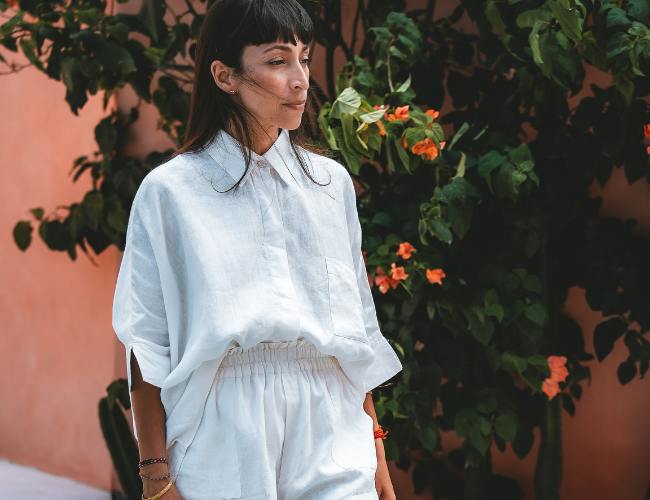
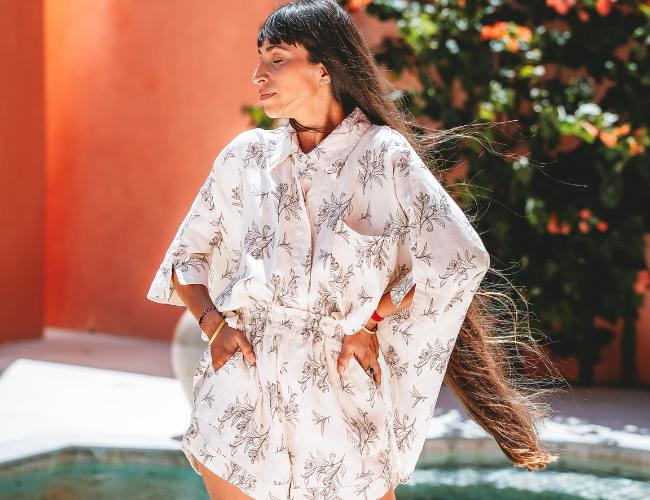
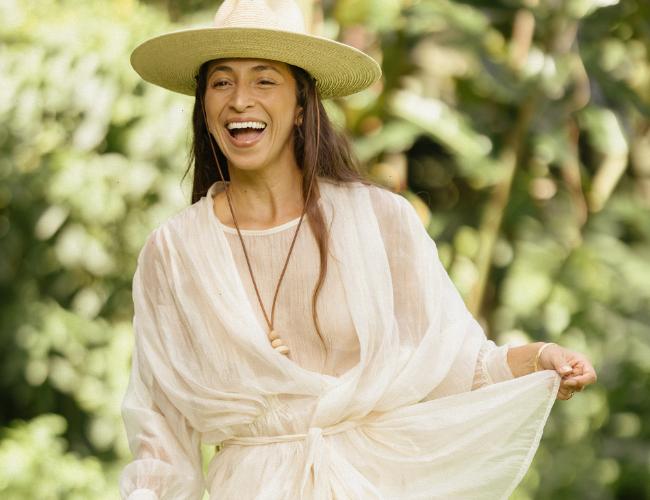
Our clothing has been worn by women through pregnancy and postpartum, through grief and ceremony, through divorce and marriage, through Saturn Returns and quiet ordinary mornings. By women in size 2 and size 22. By women in Malibu and Marrakech, in Bali and Brooklyn, in yoga studios and grocery stores.
We do not make clothing for a single body type or a single kind of life. We make clothing for women who are living fully, in whatever form that takes for them right now.We are committed to representation that reflects this. In our imagery, in our storytelling, in the community we build around the brand. We will always have more work to do here. We know that. We are committed to doing it.
How We Show Up
We are a small, independent brand run by real people with real values. We do not always get everything right. When we fall short, we say so, and we work to do better.
What we can promise is that we will never be dishonest about what we are, what we make, or what we believe.
This is the brand we are building. Slowly, on purpose, by hand.Fashion, at its best, is not consumption.
It is ceremony.