
The origin
It didn't begin with fashion. It began with a feeling.
Mayra grew up as a woman of color, Mexican-American, carrying the weight of invisible ceilings that told her how far she was allowed to go. She didn't accept them. She doodled. She dreamed. She bought beautiful things and imagined making them herself. For years, the vision lived quietly inside her, waiting for the right moment to step forward.
That moment came through movement. Through community. Through a yoga and music festival called Bloom that she and Robindra built from nothing in Canada. For seven years, they gathered people together around music, breath, and the radical idea that life should feel sacred.
Bloom wasn't just a festival. It was a proof of concept. That when you follow the dream, the dream finds you back.
An invitation to India arrived not long after. A chance meeting with a manufacturer who had quietly made garments for Free People and Anthropologie. Four designs sketched on a napkin before the flight home. And a first piece, the Kundalini Gown, worn on stage by Marianne Williamson at the next Bloom festival in Canada.
That was the beginning.

The Bloom festival, Canada. Where it all started.
Before Bali
She was already building something. She just hadn't found the container yet.
Myrah grew up in East Los Angeles. Mexican-American, deeply rooted in a neighborhood that had its own rhythm, its own code, its own kind of beauty. She was never someone who sat still. She was teaching eighteen yoga classes a week, walking dogs between studios, living the kind of life that looks scattered from the outside and makes perfect sense from the inside.
She landed a role at Interscope Records, working in A&R. Music was another kind of body work for her — feeling out what resonated, what had soul, what would last. She was part of the team that helped bring Amy Winehouse to American audiences. She understood early that the things worth paying attention to always have a realness to them that you can't manufacture.
She went to university to study kinesiology — the formal science of how the body moves. It turned out she had been studying this her whole life already.
The combination of yoga and kinesiology gave her something most fashion designers never have: a deep, trained understanding of the body as a living thing. How it breathes. How it holds tension. How a garment can either work with it or against it. She didn't design from a sketchbook alone. She designed from the inside out.
She went on to work as a buyer for fashion brands and boutiques — learning the business end, the sourcing, the eye for what sells and why. And in true California fashion, she taught herself design on the side, threading it in between everything else she was already doing. No dramatic pivot. No quitting everything to follow a dream. Just a woman who kept adding threads until one day she looked down and realised she had been weaving the whole time.
Growing up Mexican-American in East Los Angeles gave Myrah a bone-deep understanding of what it means to be rooted. Color, texture, ceremony, and identity were never abstract concepts. They were the wallpaper of her childhood.
Before she ever cut a pattern, she had spent years studying how the human body actually moves. That knowledge lives in every silhouette she creates — in the drape that gives, the hem that floats, the fabric that breathes.
Working in music taught her to trust her instincts about what is real and what is performance. She was part of the team that brought Amy Winehouse to American audiences. That standard — never fake, never forced — never left her.
Working as a buyer gave her the business fluency most designers skip. She learned what moves, what stays, what lasts — and quietly taught herself to design on the side, in true California fashion, without making a single announcement.
The practice
She didn't just study yoga. She volunteered six months to earn the right to learn it properly.
Kundalini yoga is not something you walk into. The teacher training with Gurmukh at Golden Bridge Yoga in Los Angeles is one of the most respected programs of its kind. Myrah wanted access to it. And rather than wait or find a shortcut, she showed up every day as a volunteer for over six months until she had earned her place in the room.
That is who she is. Not someone who waits for doors to open. Someone who turns up and makes herself useful until they do.
She still teaches. Two Kundalini yoga classes a month with Live Kick Studios, years after the training, years after Bali, years after the brand became what it is. Not because she has to. Because she is, at her core, a student of life who keeps showing up for the practice. That quality — the willingness to be a beginner, to sit in service, to learn before leading — runs through everything she has ever built.
The first thing the Kundalini tradition teaches you is that you are not the teacher. You are a channel. Myrah carries that with her into everything she makes.
From Golden Bridge, she followed a thread that led her deeper into the world of ceremony. Her dear friend Taylor Eyewalker, also part of the Los Angeles Kundalini community, had gone deep into the world of traditional tea ceremony — Cha Dao, the Taoist path of tea. Myrah followed that thread too, not casually, but in the same way she follows everything: all the way in.
Tea ceremony is, at its heart, a practice of presence. Of making the ordinary sacred. Of slowing down long enough to be actually here, in this moment, with this cup, with these hands. It is a daily act of meaning-making. Myrah went deep into that world. And it changed everything.
It became the philosophical spine of this company. The idea that life is ceremony. That how you begin your morning, how you dress yourself, how you receive a guest, how you hold a cup — all of it can be approached with the same reverence. None of it is too small to be done with intention. That is not a marketing angle. It is a way of living that Myrah has practiced for years and chosen to build a brand around.
Life is ceremony. This was not a tagline someone wrote in a meeting. It was a way of living that Myrah practiced for years before it became the orientation of everything we make.
The mission
We exist to dress the woman who is returning to herself.
Not arriving. Returning. Because she already knows who she is, somewhere underneath the noise of a world that moves too fast, demands too much, and profits from her forgetting.
Myrah Penaloza is the antidote to that world. Clothing handmade slowly, with devotion, by families in Bali who are paid fairly and treated with dignity. Natural fabrics that come from the earth and return to it. Colors harvested from tea leaves, sunsets, and coral reefs that exist nowhere else.
We are against copy-paste culture. Against fast fashion and fast life. Against a world that tells women to keep up when what they need is to slow down. To reconnect with the earth. To reconnect with themselves. To move from the yoga mat to the market to the temple without changing, because the woman wearing this piece has nothing to prove and nowhere to perform.
Empowering women is not a line item in our values document. It is the reason we get out of bed. It is in the artisan women in Bali whose skills we invest in and whose potential we refuse to put a ceiling on. It is in the women around the world who find this brand when they are ready to stop shrinking. It is in every piece that says, without words: you are enough, exactly as you are, and you deserve to be dressed like it.
We make clothing for the woman who values meaning over marketing, and quality over quantity.

The hands that make every piece. Bali, every morning.
The clothing
Made to be worn for years, not seasons.
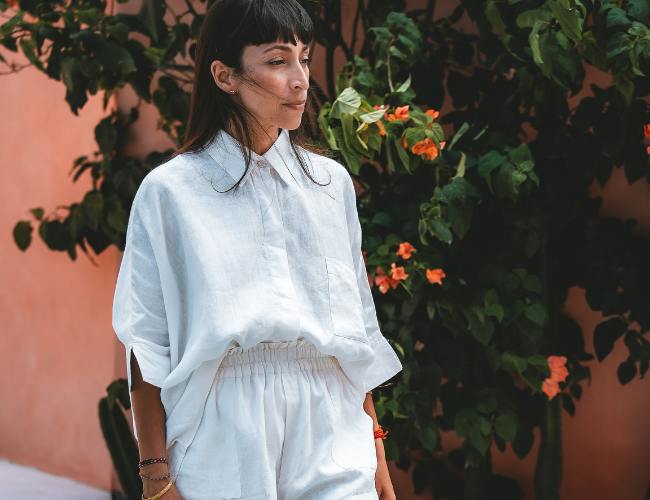
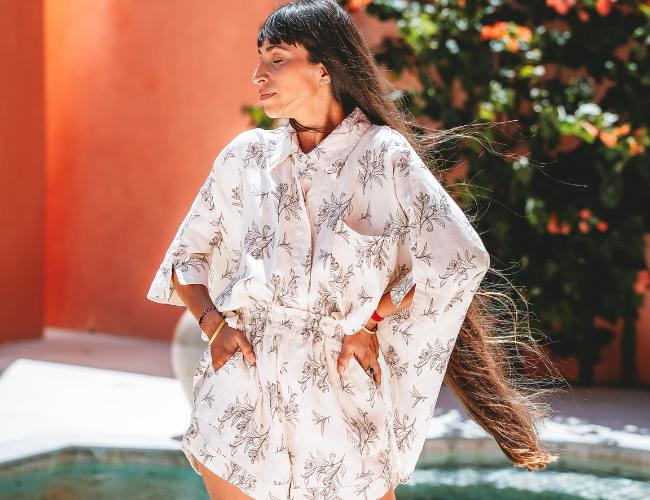
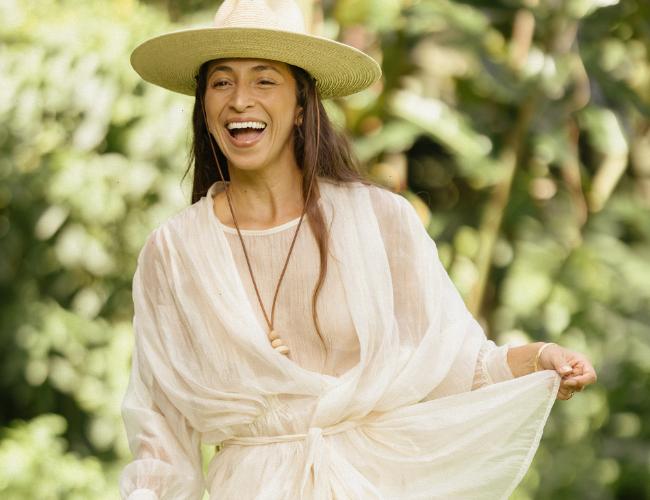
Every piece begins with a single question. How will she feel when she puts this on? Not how will she look. How will she feel. The answer guides everything. The silhouette. The weight of the French linen. The fall of the hem. The colorway that arrives by accident in a vat of tea leaves and ends up being the one we keep.

Rainbeau. Sunset purples, blues, and pinks. You cannot put it on and not be happy.
Our certifications
French Linen. Certified clean, certified traceable.
We have always believed that what touches your skin should be held to the highest possible standard. These certifications are not marketing. They are the independent verification that what we say about our French linen is true.
All linen products
OEKO-TEX® Standard 100
Every linen piece we make is certified to the OEKO-TEX® Standard 100 — the global benchmark that guarantees the finished fabric is free from harmful substances, including chemicals not yet legally regulated. What touches your skin should never be a question.
Lighter colorways
European Flax®
Our off-white, clay, natural, and other lighter-coloured linens carry the European Flax® certification — confirming our flax is grown in Western Europe (France, Belgium, or the Netherlands) without irrigation, GMOs, or waste. Full traceability, from field to fabric.
The founders
The Architect and the Artisan.
Mayra is Mexican. Robindra is Indian. Between them, they carry two ancient cultures that have always understood what the modern fashion industry forgot. That clothing is ceremony. That the hands that make it matter as much as the body that wears it.
They brought those worlds together in Bali, where the same values live in everything. In the offerings left at temple doors each morning. In the way a family blesses their workspace before the first stitch of the day. That fusion of Mexican artistry, Indian heritage, and Balinese spirituality is what makes this brand unlike anything else in conscious fashion.

Mayra & Robindra
"We build it beautifully. We let it compound. Two earth signs, one ten-year horizon, and a lot of patience."
What we believe
Six things we have never compromised on.
The vision
The Bloom festival never really ended. It just grew.
In ten years, Myrah Penaloza supports hundreds of artisan families across Bali, India, and beyond. Our way of making becomes a model the fashion industry looks to, not away from.
A wellness retreat center somewhere in the mountains. A tea house. A yoga shala. A meditation space. A boutique where slow fashion and ritual live side by side. A small number of physical stores, each one closer to a sanctuary than a shop. Places where you come for tea, stay for stillness, and leave wearing something that feels like it was made for you. Because it was.

"The woman wearing this piece is not asking the world for permission. She is reminding herself she never needed it."
Myrah Penaloza