




The question handed back
for ten years i studied tea with a teacher i had never sat across from. this year, in taiwan, i finally poured for him. what i brought home was not an answer. it was a quieter way of asking.
Zen Buddhism has no oracle in the way Delphi did, and in a sense Zen is built to refuse one. Buddhist temples across East Asia do keep oracles, the fortune sticks known as the Oracle of Kuan Yin in Chinese temples and the omikuji paper fortunes of Japan, and tea culture has long read meaning in the cup. But the Zen answer to a question is to hand it back to you, through the koan and through practices of attention like tea. The oracle in Zen and tea is not a voice that tells you what will happen. It is the quality of stillness in which you finally hear what you already know.
This is the second letter in our Oracle series. The first looked at what an oracle is from Delphi to Mexico to The Matrix. This one sits closer to home, at the tea table, where most of my own listening happens.
Does Zen Buddhism have an oracle?
Not in the classical sense. There is no Zen priestess who enters trance and speaks for a god. What Zen has instead is the koan, a short dialogue or question from the old teachers that cannot be solved by thinking. You carry it, sometimes for years, until something in you shifts.
One of my favourites is a case collected in the Book of Equanimity, a thirteenth century Chan collection of one hundred koans. A teacher named Dizang asks a travelling monk where he is going. The monk says he is wandering. The teacher asks why. The monk admits he does not know. And the teacher answers that not knowing is the most intimate thing.
That is the Zen oracle. Not a prediction. A refusal to rush the question.
What is the Oracle of Kuan Yin?
In Buddhist and Taoist temples across China, Taiwan, Hong Kong and Southeast Asia, you will see people kneeling with a bamboo cup of numbered sticks, a practice called kau cim. In Buddhist temples it is sometimes called the Oracle of Kuan Yin, after the bodhisattva of compassion. You hold your question, shake the cup gently until a single stick falls, and the number leads you to a written verse. Then you toss two small crescent blocks to ask whether you have understood.
What I love about it is that second step. The practice does not trust the first answer. It asks you to check, with humility, whether you heard correctly. Kuan Yin is a name that lives in our own collection too, and she has always been, to me, the one who hears.
What are omikuji at Japanese temples?
Omikuji are paper fortunes drawn at Shinto shrines and Buddhist temples in Japan. You make a small offering, draw a slip at random, and read your fortune for love, travel, health, study, even lost things. The tradition is traced to a tenth century monk named Ryōgen, whose one hundred prophetic verses were said to have been revealed by Kannon, the Japanese name for Kuan Yin.
If your fortune is unkind, you do not carry it home. You tie it to a tree or a wire on the temple grounds and leave it there. There is a lovely pun inside the custom: the word for pine tree, matsu, sounds like the verb to wait. The bad luck waits with the tree. You walk on.
I think about this often. Not every message is meant to be carried. Some you receive, and then you tie them to something larger and let them go.


The Osmanthus Set in Matcha, cut for the tea table.
Where do tea and the oracle meet?
They share the same ground, quite literally. The oldest Chinese writing we have survives on oracle bones from the Shang dynasty, questions asked of the ancestors and read in cracks of heated bone. The civilisation that first asked those questions is the same one that gave the world tea.
Reading the leaves left in a cup, which the West calls tasseography, is often said to have begun in China soon after tea itself, and it became a parlour custom in Europe once tea arrived there, with special fortune-telling cups sold by the late nineteenth century. In the Ottoman world, from around the 1500s, the same was done with the grounds of Turkish coffee.
But in the tea lineage I have practised, the cup is not asked to predict anything. It is asked to be poured with complete attention. I wrote about that practice in Cha Dao, the way of tea. Tea is a teacher that does not raise her voice. She waits for you to come quiet enough to hear her.
How do these practices compare?
| Practice | Tradition | How it works | What to take from it |
|---|---|---|---|
| Koan | Chan and Zen Buddhism | A question you carry until thinking gives way | Not knowing can be intimate |
| Kau cim | Chinese Buddhist and Taoist temples | Shake numbered sticks, read the verse, confirm with blocks | Check that you heard correctly |
| Omikuji | Japanese shrines and temples | Draw a paper fortune, tie the unkind ones to a tree | Not every message is yours to carry |
| Tea leaf reading | China, then Europe | Patterns left in the cup are interpreted | Look at what remains |
| Cha Dao | The way of tea | Water, leaves, bowl, silence, attention | The answer arrives in the quiet |
A tea practice for a question you are carrying
You do not need a temple or a teacher for this. You need twenty undivided minutes, a bowl or cup, and loose leaf tea.
- Write the question once. One sentence, on paper. Then turn the paper over. You are not going to keep asking it.
- Boil the water slowly. Listen to the kettle change its sound. This is the threshold, the climb up the mountain.
- Pour with both hands. Watch the leaves open. Do not reach for your phone. Do not narrate.
- Drink the first bowl in silence. Notice the first thing you feel in your body, not the first thing you think.
- Stay with not knowing. If an answer arrives, let it. If none does, that is the koan. Pour again.
- Tie off what is not yours. If a worry has come with the question, name it and leave it at the table, the way you would tie an omikuji to a tree.
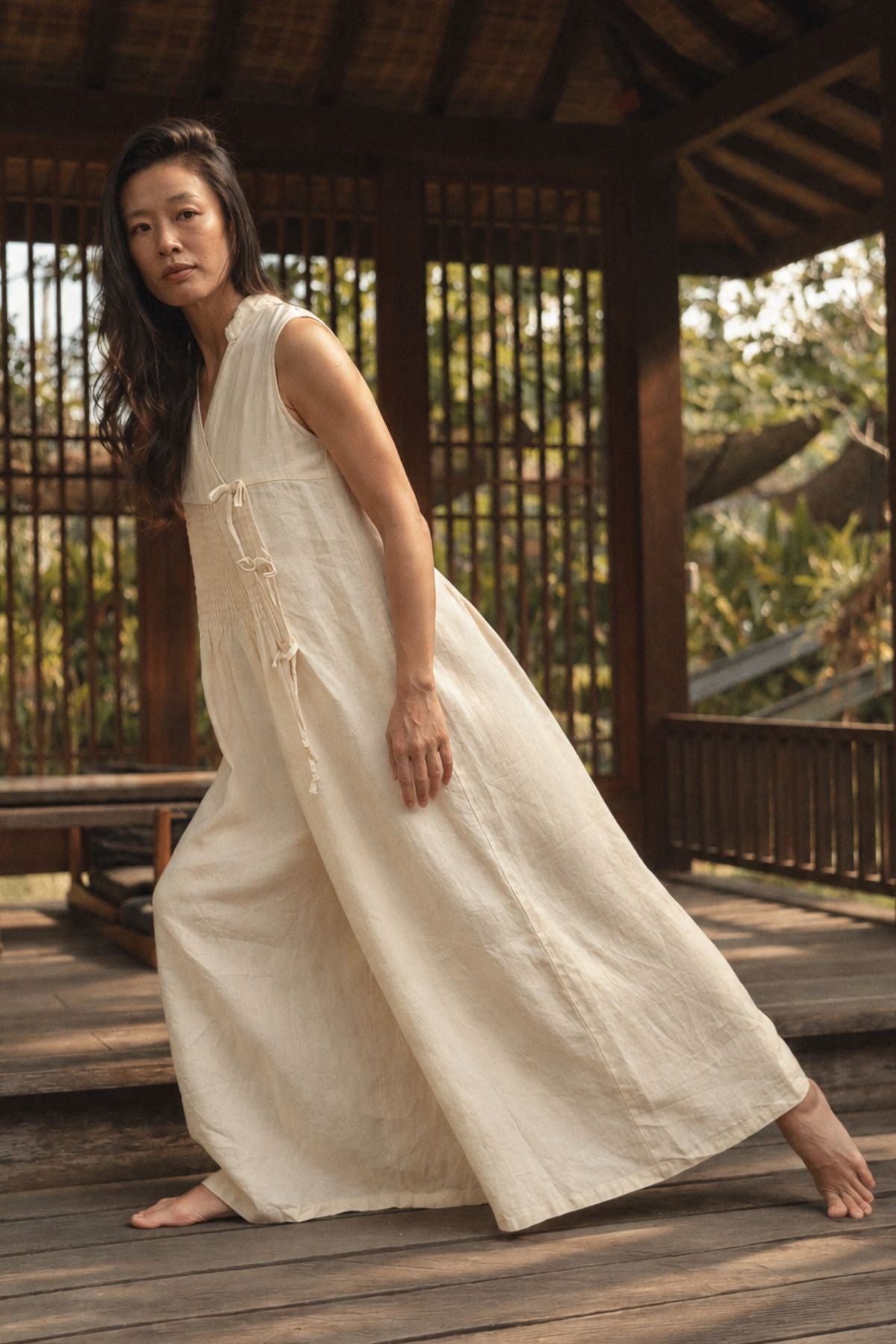
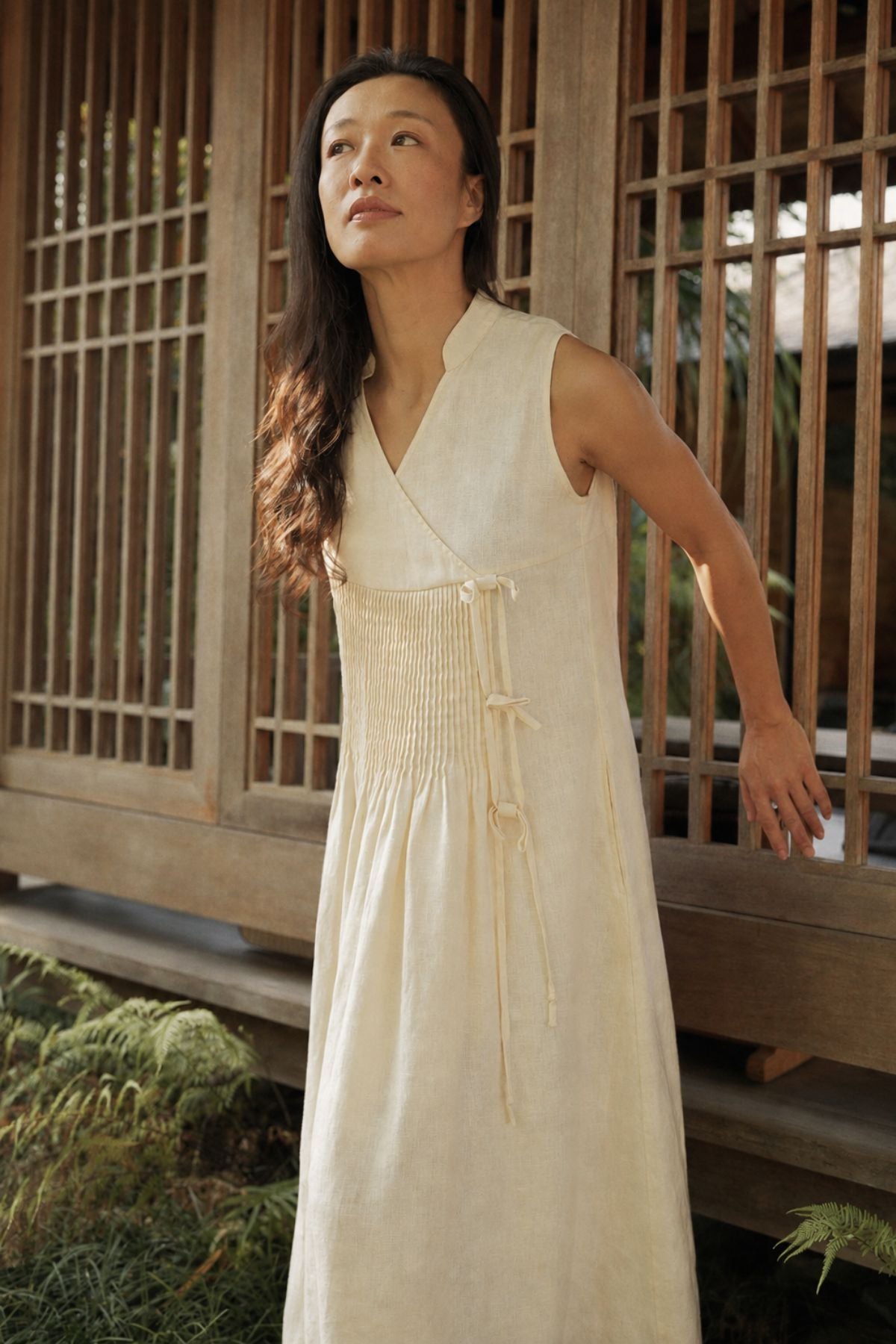
Wear something you can sit in for a long time without adjusting. It matters more than you would expect, which is why I wrote a whole guide to what to wear to a tea ceremony. The Osmanthus Set in our Oracle Collection was cut for exactly this: a kimono jacket and oversized trousers in botanically dyed Matcha linen, named for the small gold flower used to scent oolong and green tea. The flower you smell before you see it.
Frequently asked questions
Does Zen Buddhism use oracles?
Not in the classical sense. Zen has no trance medium or prophecy. Its closest equivalent is the koan, a teaching question that cannot be solved by reasoning and is carried until insight arrives. Many Buddhist temples in East Asia do offer divination such as fortune sticks and omikuji, but these sit alongside Zen practice rather than at its centre.
What is the Oracle of Kuan Yin?
It is a name for kau cim, a temple divination practice in which a person holds a question, shakes a cup of numbered bamboo sticks until one falls, and reads the matching verse. Two crescent blocks are then tossed to confirm the answer. It is associated with Kuan Yin, the bodhisattva of compassion.
Why do people tie omikuji to trees?
People tie unfavourable omikuji fortunes to a tree or wire at the temple so the bad luck stays there rather than going home with them. The custom plays on the Japanese word matsu, which can mean pine tree or to wait.
Can you read tea leaves?
Tea leaf reading, or tasseography, interprets the patterns leaves leave in a cup and is a long-standing folk practice. In contemplative tea traditions such as Cha Dao, the emphasis is different: the cup is not read for predictions but poured with full attention, so that clarity can arise in the quiet.
What is a koan?
A koan is a short story, dialogue or question from the Chan and Zen tradition, used in practice to move the mind beyond ordinary reasoning. A student carries it, sometimes for a long time, until understanding arrives through direct experience rather than analysis.
With love from Bali,
Myrah
|
A Piece for This Threshold The Osmanthus Set. Shop the Osmanthus Set → |
|
The Muse-Letter Dress for the woman you're becoming. Join the Muse-LetterUnsubscribe any time. No spam, ever. |

















Leave a comment
This site is protected by hCaptcha and the hCaptcha Privacy Policy and Terms of Service apply.