




Human Design Profile Lines: What the Two Numbers in Your Chart Actually Mean
Your Human Design profile is the two numbers separated by a slash, and it is the part of the chart most people skip. Type tells you how your energy works. Authority tells you how to decide. The profile tells you the shape your life is likely to take, which is a stranger and more useful thing to know.
There are six lines and twelve profiles. The first number is conscious, how you experience yourself. The second is unconscious, how others experience you before you have said anything. Most of the friction in a life sits in the gap between those two.
"You are not required to become someone. You are required to stop apologising for the shape you already are."
What the Six Human Design Profile Lines Mean
In Human Design, the six lines are described as the hexagram lines of the I Ching, read from the bottom of a structure to the top. The lower three are inward. The upper three are outward.
Line 1, the Investigator. Needs foundation before movement. Reads the whole manual. Insecurity here is not anxiety, it is the honest signal that the ground is not yet solid.
Line 2, the Hermit. Naturally gifted at something she did not train for and often cannot name. Needs solitude to function, and is called out of it by people who see the gift before she does.
Line 3, the Martyr. Learns by trying, breaking, and trying differently. What looks like failure from outside is the actual method.
Line 4, the Opportunist. Everything arrives through people already known. Networks, not applications. Leaving a role before the next one is secured tends to hurt more here than anywhere else on the wheel.
Line 5, the Heretic. Projected upon. People arrive expecting rescue and the reputation runs ahead of the person. Carries practical, universal solutions and pays for them in being constantly misread.
Line 6, the Role Model. Lives in three distinct phases. The first thirty years in experiment, the middle years watching from a distance and gathering, then a return with something worth saying. The middle stretch feels like being sidelined. It is not.
How to Read Your Own Profile
The twelve combinations are 1/3, 1/4, 2/4, 2/5, 3/5, 3/6, 4/6, 4/1, 5/1, 5/2, 6/2 and 6/3. If you already have a free chart, the profile sits beside the birth data. If you do not have one yet, the five types explained honestly is the place to start, and the seven authorities covers the decision-making layer.
Read the first number as the story you tell about yourself. Read the second as the thing people notice at the door. A 3/5 knows herself as someone who learns the hard way and is met as someone expected to fix things. A 2/4 knows herself as someone who needs to be left alone and is met as someone everybody wants at dinner. The tension is the design, not a fault in it.
The Two Charts This Business Was Built On
Robindra and I had our blueprints made separately, by the same practitioner, and did not compare them for a long time.
My chart is a Manifesting Generator with Emotional Clarity as the authority. Nothing is decided in the moment. I sleep on it, feel the whole wave, and commit only when the nervous charge has left and something quieter arrives. Robindra is a Generator with a gut authority, the opposite tempo entirely. His body knows in the first half second, and the sacral yes arrives before he has words for it. Different type, different clock, different arguments.
The profile pages came back identical. Both describe the same person: naturally gifted, an embodied role model, wise beyond her years, carrying what the reading calls a hermit quality, needing solitude to recharge, living life in three stages with the middle years spent observing rather than performing. And this line, which we have read out loud to each other more than once: your talent is so innate that you may not recognise your gifts as talents, and it will be called out by others rather than found by seeking.
That is the second line and the sixth sitting side by side. It explains the shape of this brand more accurately than any strategy document we have written, and it is why we work the way we do, which running a business as two different designs goes into properly.
What a Profile Is Not
Human Design has no peer-reviewed evidence base. It is a synthesis assembled in 1987 from the I Ching, astrology, the chakra system and the Kabbalistic Tree of Life, and it has never been tested the way a psychological instrument is tested. When you read that a line 2 needs solitude, the honest phrasing is that Human Design describes line 2 as needing solitude. Nobody has measured it.
I use it anyway, as a mirror rather than a verdict. The value of a profile is not prediction, it is permission. The 6 stops apologising for the fallow decade. The 2 stops explaining why she cancelled. The 3 stops calling the last four attempts a waste. If it does not do that for you, put it down.
Common Questions About Human Design Profile Lines
What are the 12 Human Design profiles? The twelve profiles are 1/3, 1/4, 2/4, 2/5, 3/5, 3/6, 4/6, 4/1, 5/1, 5/2, 6/2 and 6/3. Only these twelve combinations occur, because the two lines are drawn from the Sun and Earth positions in the chart, which fall in a fixed relationship to one another.
Which number in my profile is conscious? The first. The first line comes from your Personality, marked in black on the chart and calculated from the moment of birth, and it is how you experience yourself. The second comes from your Design, marked in red and calculated from roughly three months before birth, and it is how others experience you.
What is the rarest Human Design profile? Profiles are far more evenly distributed than types, so no profile is rare in the way a Reflector is rare. The 4/1 and the 5/2 are the two described as fixed profiles, meaning the person is less able to move between roles, and they turn up less often in conversation than the 3/5 or the 6/2.
Does your Human Design profile change with age? The profile itself never changes. Line 6 is the only line with a stated timeline built into it, moving through three phases at roughly thirty and fifty. Everyone else lives the same two lines the whole way through, in deepening ways.
What is the difference between profile and type? Type is mechanical and describes how your energy is built and how you are meant to engage. Profile is characterological and describes the role you play and the way your life tends to unfold. Two Generators with different profiles will live very differently.
If the profile lands and you want the next layer, the Gene Keys take the same chart and read it as a contemplation rather than a description. They also handle lines differently, attaching one to every sphere instead of giving you a single profile, which is what the number after the dot means.
The chart cannot tell you who you are. At its best it tells you to stop fighting the way you already work.
With love from Bali,
Myrah.
A Piece for the Hermit Line
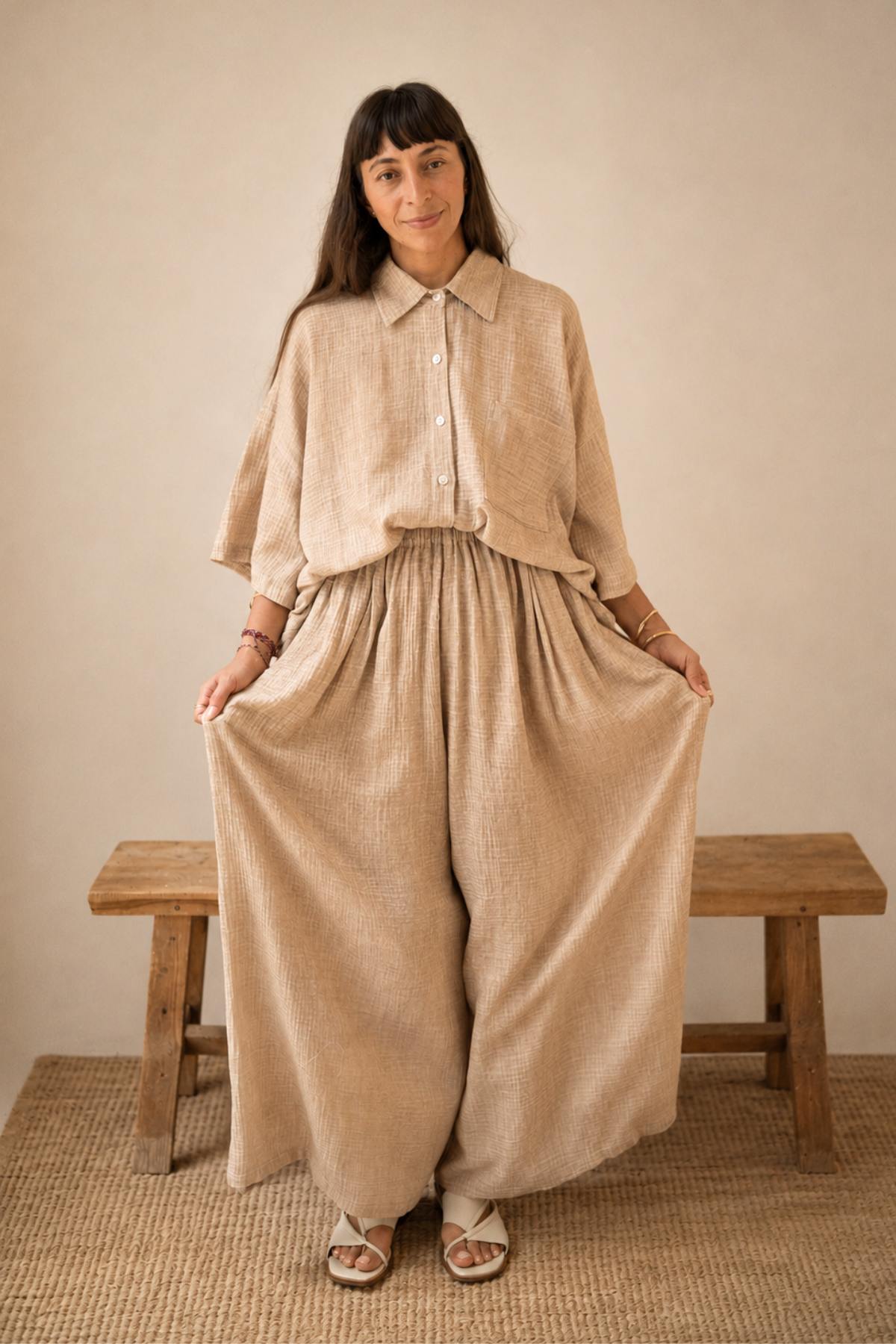
Nidra Button-Down Linen Set
Named for yogic sleep, which is the practice of resting while awake. One hundred percent French linen, a longer structured button-down over wide-leg shorts, handmade in Bali by the artisan families we have worked with since the beginning. The set for the day nobody needs you.
The Muse-Letter
Dress for the woman
you're becoming.
Every week, from Bali. The cosmic weather, the threshold you're standing on, and one piece made by hand for the woman who is ready.
Join the Muse-LetterUnsubscribe any time. No spam, ever.












Leave a comment
This site is protected by hCaptcha and the hCaptcha Privacy Policy and Terms of Service apply.