




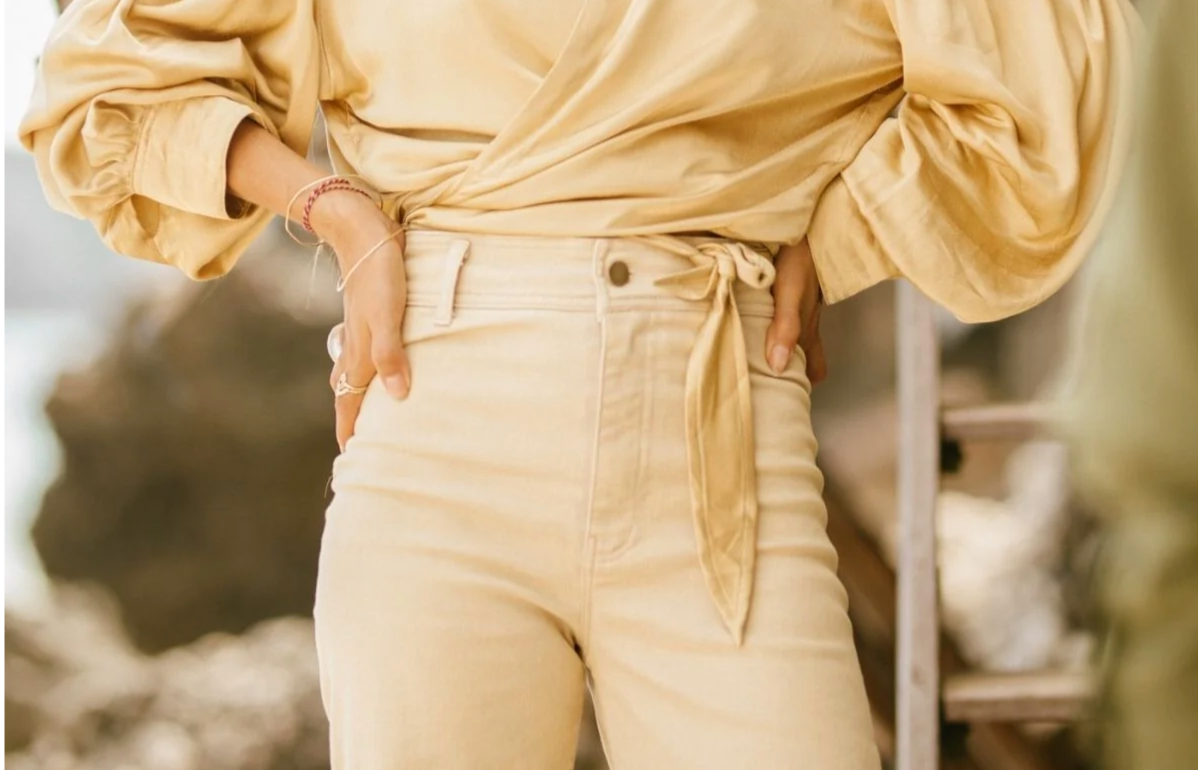
Do Cotton Jeans Stretch? The Honest Answer, From a Brand That Makes Them
There is a moment, usually somewhere around four in the afternoon, when you stand up from a chair and feel your jeans let go of you. Not dramatically. Just enough that the waistband sits a little lower than it did at breakfast, and the knees hold a soft memory of the way you were sitting. Most women read this as the jeans wearing out. It is almost always the opposite. It means they are cotton, and cotton is a living fibre that responds to a body.
So, do cotton jeans stretch? Yes. All of them, whether or not there is any elastane in the fabric. What separates a pair you keep for eight years from a pair you quietly stop reaching for is not whether they stretch. It is whether they come back.
Do Cotton Jeans Stretch, and By How Much
A pair of rigid denim jeans, one hundred percent cotton with nothing else in the weave, will typically give somewhere between half an inch and an inch and a half at the waist over a full day of wear. You will feel most of it in the first two hours. The seat and the knees move further, because those are the places where your body holds sustained tension rather than passing tension.
Wash them and much of it returns. Cotton fibres swell when they take on water and contract as they dry, which is why a pair that felt generous on Friday evening feels like a negotiation again on Sunday morning. This cycle is normal. It is the rhythm of the fibre, not a fault in the garment.
Jeans made with stretch cotton behave differently. They move further, more easily, and with far less effort from you. Ours give roughly two inches across the hip without protest. The meaningful difference is not the distance. It is the return.
Why Cotton Stretches When the Fibre Barely Does
This is the part that surprises people. Cotton, as a fibre, is not elastic. Pull a single cotton thread and it will extend a small amount and then hold that extension rather than snapping back. On its own it has very little recovery at all.
What gives denim its give is geometry. Denim is a twill, woven so the warp threads pass over two or more weft threads before dipping under, which produces that diagonal grain running across the face of the cloth. That diagonal is what allows the fabric to shift on the bias. When you sit, the weave opens along the diagonal and the threads reorganise around the shape you are making. When you stand, they mostly reorganise back.
Mostly. Over a day of wear the cloth accumulates more openings than closings, and by evening you are wearing a slightly larger pair of jeans than the ones you put on. It is a structural effect, not a chemical one, and it is why rigid denim moulds itself so specifically to one body over time. Your jeans learn you.
Stretching and Recovery Are Two Different Questions
Elastane, which you will also see written as spandex or Lycra, is not in denim to make it stretch. The weave already does that. Elastane is there to make it return.
It is an extraordinary fibre. It can extend to several times its resting length and pull itself back, and when a few percent of it is spun through cotton yarn it hands the whole cloth that ability. A jean with elastane in it will follow you through a long day and be waiting at the same shape the next morning. A jean without it will hold whatever shape you left it in until the next wash.
Elastane has one real enemy, and it is heat. High temperatures fatigue the fibre and it stops springing back. Almost every pair of stretch jeans that has gone slack and stayed slack was killed in a tumble dryer, not worn out on a body.
What We Chose, and Why We Will Name the Five Percent
Nearly everything we make is natural. Linen, organic cotton, silk, botanical dye. We are moving toward one hundred percent natural and we are not there yet, and we would rather tell you where we actually are than round the number up.
Our Vida High-Waisted Organic Cotton Jeans are ninety-five percent organic cotton and five percent elastane. That five percent is the reason the waistband still sits where you put it at the end of a fourteen-hour day, and the reason the knees do not carry yesterday in them. It is there for recovery. It is not there to make the fabric cheaper.
We debated it for a long time, because an absolute is easier to write on a website than a percentage is. But a brand that tells you it never uses a synthetic fibre, on a site where you can read the composition of the jeans, has not told you anything you can trust. You can read more about how we think about fabric on our slow fashion page.
How to Buy So the Fit Holds
The two kinds of denim ask for two opposite instincts, and this is where most disappointment comes from.
Rigid, one hundred percent cotton. Buy them snug. Uncomfortably so, almost. If they fit beautifully in the mirror on the first day, they will be loose by the third. Give the cloth the inch it is going to take anyway.
Stretch cotton. Buy them true. They will move with you and return, so there is nothing to allow for. Sizing up in a stretch jean produces a pair that sags at the seat and never recovers, because you have removed the tension the elastane needs in order to work.
The Vida is a high-waisted stretch cotton jean cut for a real waist rather than a sample rack. It runs in S 28, M 29, L 30 and XL 31, in Clay, Harvest Moon, Moonlight and Lupus Blue. If you sit between two sizes, take the smaller one. If you want the same construction in a slightly different rise, the Miley is cut from the same intention.
How to Keep the Recovery
Denim care is mostly a practice of restraint, and the shortest version is this: wash less, wash cool, and never put them in a dryer.
- Wash cold, inside out. Thirty degrees or below. Heat is what kills elastane, and cold water protects indigo and botanical dye at the same time.
- Hang to dry, away from direct sun. Hang from the waistband so the weight of the wet cloth pulls the legs straight. They will dry with the shape already in them.
- Wash them far less often than you think. Every few wears is generous for denim. Air them overnight instead. Most of what makes jeans feel unworn is moisture, not dirt.
- No fabric softener, no chlorine bleach. Softener coats the fibre and stops cotton breathing. Chlorine degrades elastane on contact.
- If they have gone slack mid-week, a cold wash and a hang dry will bring most of it back. This works on rigid and stretch denim both.
Do this and a pair of organic cotton jeans will outlast four or five fast fashion pairs bought in the same years, and will look better in year six than it did in year one. That is the whole argument for buying slowly, made in a single garment.
Frequently Asked Questions
What makes stretch cotton jeans so comfy?
Two things working together. The organic cotton is soft against skin and breathes, so the fabric moves air rather than trapping heat, and the small percentage of elastane means the cloth follows your body instead of asking your body to hold still. You are not bracing against the garment. In a well-cut high-waisted pair, the waistband also sits on the waist rather than the hip, so it stays where you put it when you sit, bend or lift.
Do stretch jeans fit everyone?
No pair of trousers fits everyone, and we would not claim otherwise. What stretch cotton does is widen the range of bodies one cut can serve well, because the fabric accommodates a difference between waist and hip that rigid denim cannot. Our Vida runs S 28 through XL 31 and is cut for a high waist. If you are between two sizes, take the smaller. Stretch denim needs a little tension against the body in order to recover its shape.
Can I wear stretch jeans for sports or lots of moving around?
For a long day of walking, travelling, cycling to the market or moving through a full schedule without changing, yes. That is exactly what the fabric is for. For actual training, running or a yoga practice, no. Denim is a heavy, tightly woven cloth that does not move moisture away from skin, and five percent elastane does not change that. Wear linen or cotton made for the purpose, and keep the jeans for the rest of the day.
How do I wash my stretch cotton jeans to keep them nice?
Turn them inside out, wash cold at thirty degrees or below on a gentle cycle, and hang them to dry away from direct sun. Never use a tumble dryer, because heat fatigues elastane and that is what causes stretch jeans to go slack permanently. Skip fabric softener, which coats the fibre, and skip chlorine bleach, which degrades elastane. Wash every few wears rather than after every wear, and air them overnight in between.
Will stretch jeans lose their shape over time?
Well-made ones lose very little, and most of what they do lose comes back in a cold wash. Stretch jeans go permanently slack for one reason far more often than any other, and it is heat. A tumble dryer, a hot wash or a radiator will fatigue the elastane so it stops springing back, and no amount of washing recovers it after that. Keep them out of heat and a good pair holds its shape for years.
What's the difference between 'comfort stretch' and 'super stretch' jeans?
The labels usually describe how much elastane is in the cloth. Comfort stretch tends to mean one to two percent, enough to soften a rigid jean without changing how it behaves. Super stretch means more, and the fabric starts to feel closer to a legging than to denim. The number on its own tells you less than people think. What matters more is what the other ninety-five percent is made of. A jean that is ninety-five percent organic cotton with five percent elastane wears, breathes and ages like denim. A jean that reaches the same stretch with a base of polyester does not, however similar the percentages look on the label.
With love from Bali,
Myrah
|
A Piece for This Threshold The Vida High-Waisted Organic Cotton Jean Shop the Vida Jean → |
|
The Muse-Letter Dress for the woman you’re becoming. Join the Muse-LetterUnsubscribe any time. No spam, ever. |














Leave a comment
This site is protected by hCaptcha and the hCaptcha Privacy Policy and Terms of Service apply.