



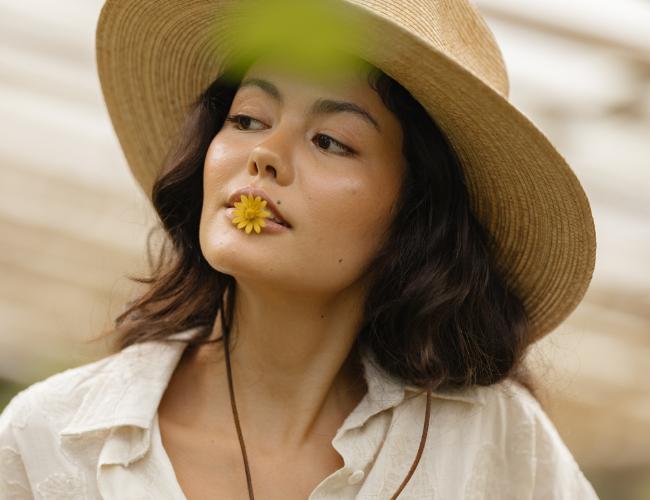

The oil I had to learn to use less of
my first year here, i oiled my hair the way i had always oiled my hair, and by november i had ruined it.
Not dramatically. Nothing fell out. It simply stopped behaving like mine. Flat at the root, heavy at the crown, and by the third day a dullness I could not wash out no matter how much I stripped it. I blamed the water. I blamed the dye. It took me most of a year to understand that I had brought a cold country's ritual into a climate that runs at eighty percent humidity and expected it to translate.
It does not translate. The oil is not the problem. The amount is, and the timing is, and almost nobody tells you that, because almost every hair oiling instruction you will ever read was written by someone living somewhere dry.
Why the ritual you were taught does not survive humidity
In dry air, oil is doing two jobs. It is conditioning the strand and it is replacing moisture the air has taken. You can be generous, because the environment is pulling against you the whole time.
In humid air the second job is already done. The air is handing your hair water constantly. So the oil has nothing to counterbalance, it simply sits, and the same quantity that made your hair beautiful in a Chicago winter will make it lank by lunchtime in Canggu. The same is true in a Sydney February, a Singapore anything, a Gulf Coast August. This is not a tropical problem. It is a summer problem that most of the world has four months of.
Start with a quarter of what you think
Here is the correction, and it is almost embarrassingly simple. Take the amount you currently use and quarter it.
For most women that lands somewhere near half a teaspoon for shoulder length hair. Warm it between your palms first, properly, until it thins and stops feeling like a substance and starts feeling like nothing. Cold oil sits on the surface. Warm oil moves in.
Then work up, not down. Most of us pour into the palm and press into the crown, which is exactly backwards in heat. Start at the ends, which are the oldest part of the hair and the part that actually wants it, and let whatever remains on your hands be all your scalp receives. If your hands feel empty by the time you reach the roots, you have done it correctly.
Where the oil actually goes
The ends. Always the ends first. The last two inches of your hair have been alive for years and have been through every wash, every tie, every hot afternoon. That is the part with something to gain.
The scalp is a different conversation and a smaller one. A scalp massage with almost no oil at all, four or five minutes of slow pressure with the pads of the fingers rather than the nails, does more for most women than a heavier application ever will. I wrote about the version of this I keep by the window in the comb I keep by the window. The pressure is the active ingredient. The oil is only what lets your fingers move.
How long to leave it, and whether overnight is a mistake
This is the question I am asked more than any other, and the honest answer has a condition attached.
Overnight is fine, if the amount is right. Overnight is the reason your hair feels heavy for three days, if it is not. In a humid climate I would rather you left a small amount in for eight hours than a generous amount in for one. The duration was never the risk. The volume always was.
If you are oiling before a wash rather than as a leave-in, forty minutes does most of the available work. Anything past about two hours is gentle diminishing returns. And if you are using rosemary oil specifically, the timing and the dilution matter more than the brand, which we went into properly in the nightly rosemary ritual.
And then there is what you sleep on
The last piece took me the longest to notice, because it is not about hair at all.
Cotton is absorbent by design. That is why we make towels out of it. Sleep with oiled hair on a cotton pillowcase and the cotton spends seven hours taking back what you spent twenty minutes putting in, and pulling at the cuticle while it does it. Linen holds its shape against the hair instead of gripping it, and it does not drink in the same way. You will notice it in the morning, at the crown, where the friction usually shows first.
Half of what I know about hair I learned by getting it wrong in a climate that would not forgive me. The correction was never a better product. It was less of the one I already had, warmed properly, put in the right place, and then left alone.
With love from Bali,
Myrah
|
A Piece for This Threshold The Bali Linen Pillowcase. Natural French linen, botanically dyed and stonewashed by the same artisan hands that make the collection. Four colourways, each from its own dye run, none of them identical to the last. The colour you keep returning to, followed into the room where you rest. Shop the Bali Linen Pillowcase → |
|
The Muse-Letter Dress for the woman you're becoming. Join the Muse-LetterUnsubscribe any time. No spam, ever. |
















Leave a comment
This site is protected by hCaptcha and the hCaptcha Privacy Policy and Terms of Service apply.