


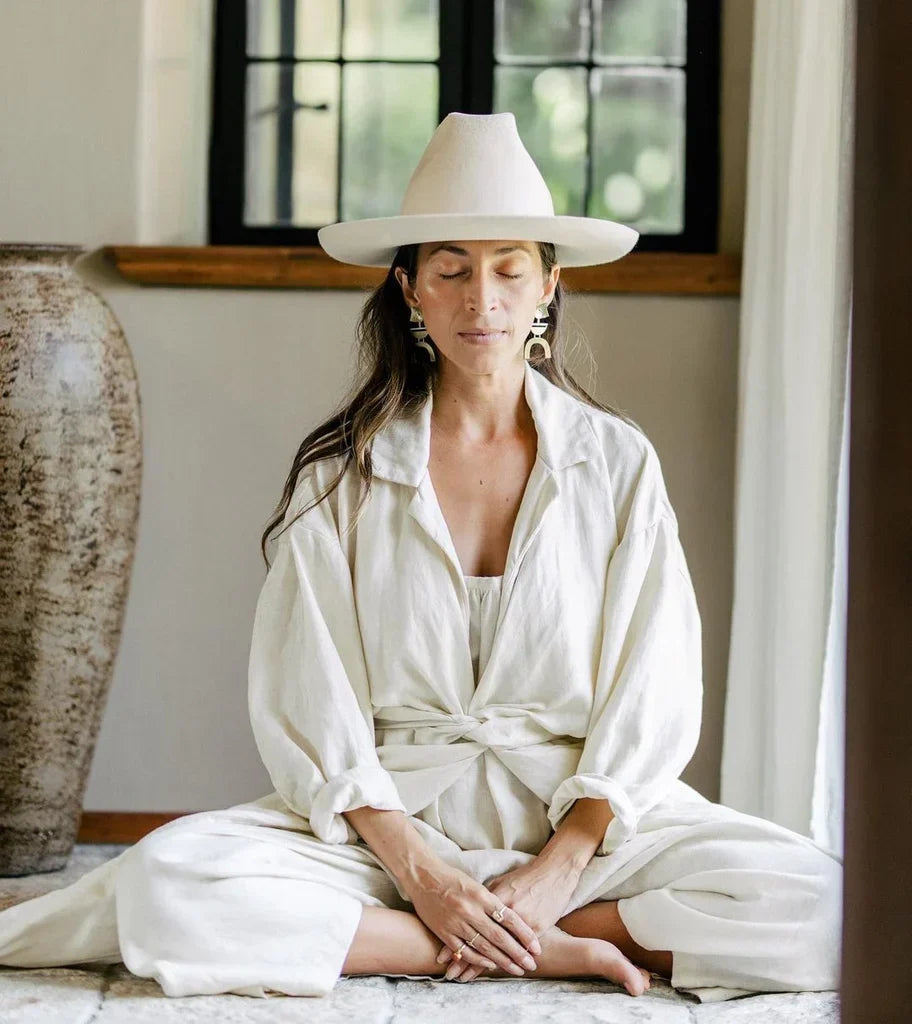
What kundalini yoga actually is
Kundalini yoga is a practice built from breath, repetitive movement, mantra and stillness, arranged into fixed sequences called kriyas. It is less about the shape of a posture than about how long you stay in it and what your breath is doing while you do. Where other yoga asks your body to become flexible, kundalini asks your nervous system to become responsive. That is the difference, and it is the whole difference.
I have practised and taught it for years, and I still find the first-timer question the hardest one to answer well, because what happens in a class does not sound like much when you write it down. So let me write it down anyway.
What actually happens in a class
You sit. Usually cross-legged, usually on the floor. Someone chants a short opening mantra and you chant it back. Then the teacher gives you a kriya, a fixed sequence of exercises done in a set order for a set length of time.
A kriya might mean holding your arms above your head for three minutes while breathing rapidly through the nose. It might mean a small repetitive movement, the same one, for eleven minutes. It is rarely difficult in the way a strong vinyasa class is difficult. It is difficult in a different way, which is that nothing distracts you from it. There is no flow to get lost in. There is one movement and there is time.
Then you lie down, and then you meditate, and then it ends with a song. The whole thing usually runs sixty to ninety minutes.
Breath is the actual practice
If you take one thing from this, take this. In kundalini the breath is not accompaniment to the movement. It is the instrument, and the movement is there to hold you still enough to use it.
Breath of fire is the one most people meet first: rapid, even, through the nose, the belly pumping on the exhale. Long deep breathing is the opposite, three or four breaths a minute, which is slow enough that most people find it uncomfortable before they find it calming. Alternate nostril breathing sits between them.
What these do is not mysterious. Sustained, patterned breathing changes your autonomic state. You can feel it happen. Whatever language you prefer for it, the practice is a way of learning that your nervous system is something you can address directly rather than something that simply happens to you.
What kundalini means
The word describes an energy said to rest at the base of the spine, coiled, and to rise through the body when the practice is sustained. The Sanskrit root means coiled, like a serpent.
You do not have to hold that literally to do this. Most long-term practitioners I know hold it as a description of something they have felt rather than a claim about anatomy, and the practice does not require you to decide which it is before you begin. Come for the breath. The rest sorts itself out or it does not.
Why practitioners wear white
This is the question I am asked more than any other, and the honest answer has two halves.
The traditional half: white is said to hold and expand the field around the body, and to reflect rather than absorb. Wearing it, the tradition holds, extends your aura by a foot in every direction.
The practical half is the one I find more persuasive. In a room where you will be moving in one small repeating way for eleven minutes, what you are wearing stops being neutral. Anything tight, anything synthetic, anything that needs adjusting keeps a quiet part of your attention on itself, and that is exactly the part of your attention the practice is asking for. Natural fibre that breathes and a cut you can sit on the floor in for an hour removes a variable.
That is why the Kundalini Gown exists, and why it is cut the way it is: one size, generous, and made to be sat on the floor in for an hour. It came out of my own practice before it was ever a product. If you want the longer version, including which fabrics survive a warm room and what to look for in a set, we wrote it out in kundalini yoga clothing: what to wear, and why the tradition asks for white.
Is kundalini yoga dangerous?
Not in the way the phrase implies. There is no evidence that it triggers anything mystical and irreversible, and the version of this question that circulates online is usually a story told by someone who read another story.
But it is not nothing either, and I would rather be plain than reassuring. Sustained rapid breathing changes your physiology quickly. It can produce dizziness, tingling in the hands, and sometimes a wave of emotion that arrives without a reason attached to it. For most people that passes and is part of the point. For some people, particularly anyone who has found intense breathwork destabilising before, it is worth beginning gently, in a room with a teacher who can see you, rather than alone with a video. If you have a heart condition, are pregnant, or have any history that makes intense breathwork inadvisable for you, speak to your doctor first and tell your teacher.
The correct instruction, always, is that you may stop. Breath of fire is not a test. Lower your arms. Breathe normally. Nothing is lost.
A word about where this lineage comes from
Kundalini yoga as it is taught in the West largely arrived through Yogi Bhajan, who began teaching in the United States in 1969. In 2020 an independent investigation commissioned by his own organisation concluded that he had more likely than not sexually abused students over many years.
I am not going to write around that. A great many of us who love this practice have had to do the work of separating what we were given from the man who gave it, and that work is ongoing and it is not tidy. What I can say is that the breath is older than he is. The kriyas draw on a tradition that long predates his arrival in California, and the women I practise with now are building something more careful than what they inherited. If you are coming to this fresh, choose a teacher who is transparent about lineage and who does not ask you to hand over your judgement at the door.
How to begin
- Start with three minutes. Not thirty. One kriya, three minutes, most mornings.
- Go to a class before you go to a video, if you can. A teacher who can see you is worth more than a good camera angle.
- Wear something you can sit on the floor in for an hour without adjusting. Natural fibre. Nothing tight at the waist.
- Do it at the same time each day rather than for the same length of time. Consistency is the variable that matters.
- Expect it to be boring before it is anything else. That is not a sign you are doing it wrong.
Frequently asked questions
What is kundalini yoga in simple terms?
A practice built from breath, repetitive movement, mantra and stillness, arranged into fixed sequences called kriyas. It works on the nervous system rather than on flexibility, and the breath rather than the posture is the main instrument.
How is kundalini yoga different from hatha or vinyasa?
Hatha and vinyasa are organised around postures and the transitions between them. Kundalini is organised around breath and duration: one movement, held or repeated for a set length of time, with a specific breath. There is no flow to get lost in, which is what makes it feel harder than it looks.
What is a kriya?
A fixed sequence of exercises done in a set order for a set time, always ending in stillness. A kriya is not improvised. The order and the timing are the point.
Is kundalini yoga dangerous for beginners?
Not in the way the phrase suggests. Rapid breathing can cause dizziness, tingling and unexpected emotion, which usually passes. Begin gently, with a teacher in the room if you can, and stop whenever you want to. If you are pregnant, have a heart condition, or have found intense breathwork destabilising before, speak to your doctor first and tell your teacher.
Why do kundalini yogis wear white?
Traditionally, because white is said to expand and protect the field around the body. Practically, because holding one position for eleven minutes makes anything tight or synthetic impossible to ignore. Natural fibre and a loose cut remove a distraction the practice cannot afford.
What is a kundalini awakening?
The term describes the energy said to rest coiled at the base of the spine rising through the body. Practitioners describe it in very different ways, from a gradual steadying to something sudden and disorienting. It is not a goal to chase, and a sustained daily practice matters more than any single experience.
With love from Bali,
Myrah

|
A Piece for This Threshold The Kundalini Gown. Shop the Kundalini Gown → |
|
The Muse-Letter Dress for the woman you’re becoming. Join the Muse-LetterUnsubscribe any time. No spam, ever. |


















Laisser un commentaire
Ce site est protégé par hCaptcha, et la Politique de confidentialité et les Conditions de service de hCaptcha s’appliquent.